

🌊 Are Trump’s Tariffs Numbered?
We break down the arguments surrounding Trump’s application of “reciprocal tariffs”
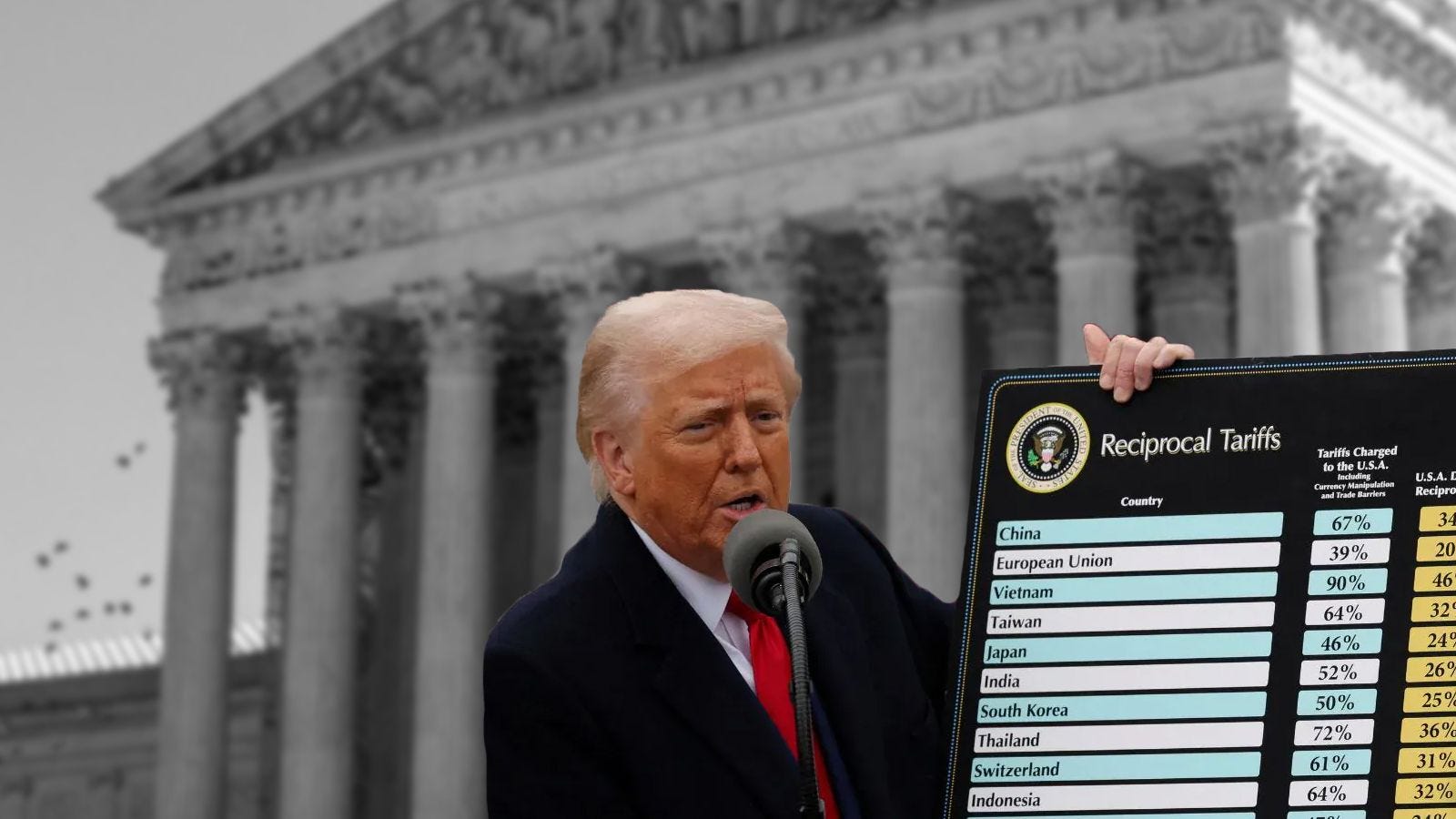
On April 2, President Trump declared “Liberation Day.” Citing a national emergency over the trade deficit, Trump invoked IEEPA, a 1977 law, to apply tariffs to over 100 countries.
In the months that followed, Trump leveraged those tariffs to extract concessions from and negotiate deals with a slate of major trading partners. By last month, around half of imports into the US were subject to tariffs. This is bringing billions into the government: The Committee for a Responsible Federal Budget (CRFB) reports that tariffs generated $195B in FY 2025, more than double the total from FY 2024.
Trump and his backers celebrated those figures as proof that tariffs can lower the deficit, bring back manufacturing, and improve American security. Yet looming over it all was a major question: Was it legal?
Last week, the Supreme Court heard arguments as to whether Trump had the right to enact tariffs without Congress’ permission. Trump called the case “literally, LIFE OR DEATH for our Country.”
Today, we examine the case before the court, the arguments around it, which way the Court seems likely to go, and the implications of the forthcoming ruling.

IEEPA – the International Emergency Economic Powers Act of 1977 – grants presidents a range of economic actions “to deal with any unusual and extraordinary threat, which has its source in whole or substantial part outside the United States, to the national security, foreign policy or economy” of the US. Presidents have used the law to restrict exports, impose sanctions, and limit certain investments.
When he invoked IEEPA, Trump cited the US’ “large and persistent” trade deficit with the rest of the world and declared a national emergency. He said that trade deficits were hollowing out US manufacturing and were a product of unfair trade policies.
A group of states and another group representing small businesses sued, alleging that IEEPA did not grant Trump the right to impose such sweeping duties. Lower courts agreed, most recently a US Appeals Court that ruled 7-4 against Trump in August, sending the case to SCOTUS.
Last Wednesday, SCOTUS heard the arguments about whether Trump’s invocation of IEEPA to lower trade deficits was legal, or whether that power belonged with Congress. Beyond being just about tariffs, the hearing was seen as a test of how the court – with a 6-3 conservative majority – is looking at Trump’s assertions of sweeping presidential power.
The hearing began with arguments by D. John Sauer, the president’s solicitor general. He argued that the president is empowered to address emergencies and foreign affairs, and that this case is not about the “power to tax” but to regulate foreign affairs. He insisted that Trump was entitled to enact tariffs as a way to conduct diplomacy: “The fact that they raise revenue is only incidental,” he said.
Beyond trying to justify the legal logic, Sauer warned that rolling back the tariffs could cause a Great Depression-level economic disruption, interrupt trade negotiations, and embarrass the US diplomatically.
The Court then heard arguments from Neal Katyal, a lawyer representing small businesses.
“Tariffs are taxes,” he declared, adding: “Our founders gave that taxing power to Congress alone.”
“It’s simply implausible” that when Congress enacted IEEPA, it “handed the president the power to overhaul the entire tariff system and the American economy in the process, allowing him to set and reset tariffs on any and every product from any and every country, at any and all times.”
He pointed to the example of Switzerland, on which Trump put a 39% tariff: “That is just not something any president has ever had the power to do in our history.”
“The president is seeking the power to set aside all of our trade treaties unilaterally under the word ‘regulate.’ I just don’t think it can bear that weight,” he said.
Following Katyal, Oregon Solicitor General Benjamin Gutman argued for a group of states that sued. He compared Trump’s policies to those of past presidents, asserting that in the past, presidents had enacted tariffs for national security but not broadly on goods coming into the country. He also sought to differentiate tariffs from embargoes, which presidents have ordered, describing them as “a different kind of pastry.”
Prior to the hearing, it was widely expected that the three liberal justices would not support Trump’s IEEPA invocation. That likely left the decision with the six conservatives.
Following the arguments, they questioned the lawyers.
Justice Amy Coney Barrett, a Trump appointee, questioned Trump’s application of “across the board” reciprocal tariffs, asking the government’s representative, “Is it your contention that every country needed to be tariffed because of threats to the defense and industrial base?...I mean, Spain? France? I mean, I could see it with some countries but explain to me why, as many countries needed to be subject to the reciprocal tariff policy, as are.”
Justice Neil M. Gorsuch, another Trump appointee, seemed similarly skeptical, warning about “a one-way ratchet toward the gradual but continual accretion of power in the executive branch and away from the people’s elected representatives.” He added that Congress may have delegated too much power to the president.
And Chief Justice John Roberts said, “The vehicle is the imposition of taxes on Americans, and that has always been a core power of Congress.” He cited the “major questions” doctrine, which says that congressional authorization is required for major administrative changes. This was used to strike down Biden’s attempt to forgive billions in student debt. Roberts seemed skeptical that the IEEPA could be used “for power to impose tariffs on any product from any country in any amount, for any length of time.”
But others – including conservatives Brett Kavanaugh and Samuel Alito – appeared worried about handcuffing the president.
Kavanaugh cited how Trump imposed a tariff on India because of its purchases of Russian oil: “That’s designed to help settle the Russia-Ukraine war, as I understand it,” he said, calling the war “the most serious crisis in the world.”
Alito seemed skeptical that Congress would allow the president to impose a ban on trade – an embargo – but not a tariff.
The liberals seemed skeptical, as expected.
Justice Sonia Sotomayor said, “What we’re forgetting here is a very fundamental point, which is the Constitution is structured so that if I’m going to be asked to pay for something as a citizen, that it’s through a bill that is generated through Congress,” she said, implying that the president doesn’t have the right to unilaterally tax the population through tariffs.
She also pointed to the case of Brazil, on which Trump applied a tariff to support former President Jair Bolsonaro, a political ally. She asked, “The point is, those may be good policies, but does the statute that gives without limit the power to the president to impose this kind of tax – does it require more than the word regulate?”
Legal analysts generally saw the skepticism of Roberts, Gorsuch, and Barrett as bad news for the administration, and odds that the “Supreme Court rules in favor of Trump’s tariffs” fell to 33% on Polymarket, a current events betting platform, after the hearing. A final decision is due in the coming weeks or months.
The stakes of the decision are extremely high: If SCOTUS does toss out the tariffs, it could lead to a complicated and costly effort to reimburse everyone and every business that paid illegal tariffs. Perhaps more importantly, it would force the Trump Administration to enact a tariff Plan B. While the administration says it has this ready, whatever follows would likely grant the president less power and flexibility than he has been operating with. It’s worth noting that other tariffs – including ones on specific sectors – will remain in place regardless of the decision. However, IEEPA has been used to justify around 60% of the tariffs implemented so far this term. Will they last into 2026? That is for the Court to decide.
Editor’s Note
What do you think: Are Trump’s tariffs legal or not? How will SCOTUS vote? Let us know by replying to this email.
Thanks for reading,
Max and Max