

🌊 Are We Getting Dumber?
Do you feel like people aren’t as smart as they used to be? You may be right.


In the 1980s, James R. Flynn – a New Zealand political scientist – noticed a trend: When IQ tests were re-administered to new generations, average scores kept going up. This meant that if you took an IQ test designed in 1950 and gave it to people in 1990, they’d score significantly higher than those from the original testing period.
Flynn’s finding became known as the Flynn Effect. In essence, it meant that we were getting smarter by around 3 IQ points per decade.
Then, something changed.
In today’s deep-dive, we look at the great IQ plateau – or even decline – to understand whether we have surpassed peak intelligence and are now becoming dumber by the day.

One of the most-cited studies to suggest that we’re getting dumber stems from one of the world’s best-educated countries: Denmark.
All Danish men must appear before a draft board when they turn 18 in order to evaluate their suitability for military service. The men can either be declared fully eligible, limitedly eligible, or ineligible, based on the results of an intelligence test and a medical examination. The system has produced an unusually comprehensive set of intelligence data, which scientists have studied for trends.
In one influential study, published in the journal PLOS One in 2021, researchers at the University of Copenhagen looked at the intelligence test scores of all men who were born between 1940 and 2000 and appeared before a draft board. The study analyzed these statistics to see how “intelligence” had changed in Danish men over time.
They found that the Flynn effect – the sustained increase in IQ scores over time – had once existed, but no longer did.
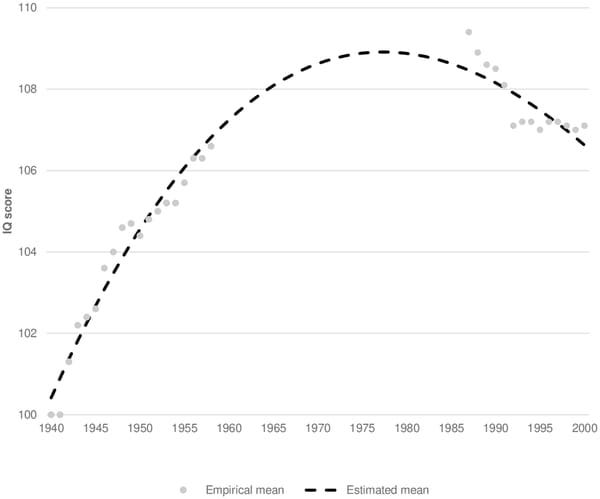
The results showed that people born from 1940 to 1980 had higher IQs, while those born after 1980 had lower IQs.
The researchers explained the pre-born-in-1980 IQ rise through improvements in education, nutrition, and smaller families, noting that “intelligence test scores have been found to decrease with increasing birth order because parents have less time and resources to spend on each child.”
Yet they didn’t fully explain the drop.
Other studies have since corroborated this trend of declining IQs in the last three decades, identifying similar ones in Norway, the UK, Finland, Austria, France, the Netherlands, and other countries. A 2016 review of 62 studies identified seven countries that met strict criteria for reporting negative Flynn effects (Denmark, the UK, Norway, the Netherlands, Estonia, France, and Finland).
A 2015 meta-analysis of IQ scores across 31 countries identified a decline in IQ scores. Some of these findings are widely accepted; others are more contentious or limited, for example, applying only to military-aged men. Yet it’s clear that the once-expected trend of consistently climbing IQ scores has stopped in the Western world.
Data in the US is harder to come by than in Europe, yet studies have identified a similar trend in America. One, published through Northwestern University in 2023, “found evidence of a reverse ‘Flynn effect’ in a large US sample between 2006 and 2018 in every category except one.”
It noted:
Ability scores of verbal reasoning (logic, vocabulary), matrix reasoning (visual problem solving, analogies), and letter and number series (computational/mathematical) dropped during the study period, but scores of 3D rotation (spatial reasoning) generally increased from 2011 to 2018, the study found.
In Asia, it’s a different story: Neither China, Taiwan, Japan, nor South Korea has experienced a reversal of the Flynn effect.
That being said, comparisons aren’t necessarily valid. There often isn’t the same level of research into their populations or data as in Western European countries. Perhaps more importantly, the Asian countries started from a much lower level of development than the European ones, meaning they may be experiencing the same effect as the West but on a lag. The data suggests these countries’ IQs are still rising, albeit at a diminishing rate. That’s what happened in the West before the declines set in.
The studies suggest that IQ declines in the West began around 1980. That means the declines predated smartphones, social media, Covid, and the other factors that have been attributed to making people less intellectual in the modern era.
A huge amount has changed in the period since that happened, including jumps in the amount of processed food consumed and the time spent on videos and video games, with drop-offs in reading and the consumption of other longer-form content. Demographers have also put forward explanations ranging from dysgenic fertility (smarter individuals having fewer children) to immigration from lower-scoring regions.
Yet the combination of modern technology with declining IQs may be a perfect storm: In 2022, a majority of Americans did not read a book in the prior year, according to the National Endowment for the Arts. The US National Assessment of Educational Progress recently found that the share of American teenagers who “hardly ever” read for fun is now around half, with the share who read “almost every day” down to ~15%, a decline from nearly 40% in 1996. Reading is highly correlated with intelligence-related metrics, both in terms of factual knowledge and comprehension.
In the US, the share of teens reading daily peaked in 1996 – reflecting those born around 1980, the year in which IQs may have peaked.
All of this is to say: It’s unclear why the Western world’s IQs are falling, or, at a minimum, why their growth has plateaued. But if you made it this far – 900 words! – you may have done your brain a service.
Editor’s Note
Thanks for reading. We’re interested to hear your takes on this one: What do you think is the cause for the declining IQ rates in the West? Are other countries doomed to follow suit? Send in your thoughts here.
See you tomorrow,
Max and Max