

🌊 Inside Chicago’s ICE Operations
A deep-dive look at what’s actually happening on the ground in Chicago
By Rob McGreevy
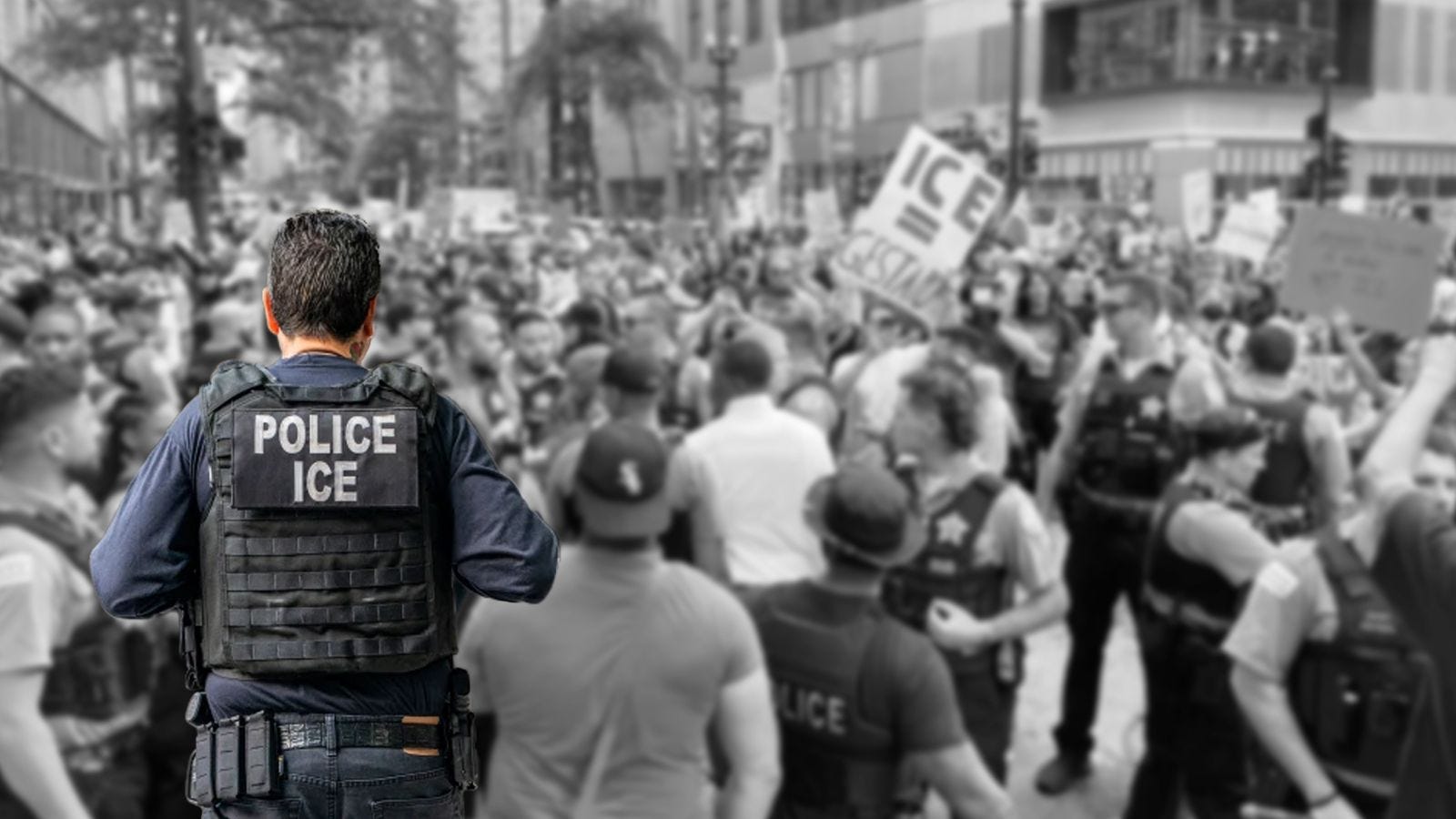
If you look on social media, Chicago is a war zone: Videos show federal agents marching through the streets, throwing people into vans, and deploying tear gas and pepper spray against those who try to intervene.
The government, meanwhile, paints the opposite picture: That its agents are reclaiming a violent city from criminals who have put all law-abiding citizens at risk.
To find out the truth, we spoke to Chicago residents, immigrants, and politicians, as well as members of the Trump Administration.

Two federal operations are currently underway in Chicago: Midway Blitz and At Large. The government said it launched the former in response to the death of 20-year-old Katie Abraham, who died during a hit-and-run caused by a Guatemalan illegal immigrant this May. (He has since pleaded guilty and been sentenced to 30 years in prison.) Operation At Large is a distinct mission “to make the city safer by targeting and arresting criminal illegal aliens.”
To conduct these operations, both Immigration and Customs Enforcement (ICE) and Customs and Border Protection (CBP) have agents in Chicago. Trump has tried to deploy the National Guard as well; however, courts have blocked it. A final Supreme Court ruling on whether Trump can deploy the Guard there may arrive next month.
So what have these agents been up to? Who are they actually detaining? That’s the subject of today’s deep-dive.
CBP and ICE have been competing for detainments. Since September 16, CBP agents have recorded roughly 1,500 in the Chicago region, just over the 1,400 made by ICE officers. While Border Patrol agents have traditionally been limited to intercepting people and drugs along American borders, Trump has repurposed them to conduct immigration enforcement raids in the country’s interior.
The federal government says that these forces are necessary to enforce the law in a self-designated sanctuary city, where local and state immigration laws allow convicted criminal aliens to roam free. The government has repeatedly pointed to cases like that of Nicaraguan national Leyter Jeferson Arauz-Medina, who is accused of assaulting and raping a 54-year-old woman in Chicago in August. The Department of Homeland Security (DHS) has sought to deport Arauz-Medina but claims that Illinois is protecting him.
This isn’t an uncommon story: “They’re fighting an uphill battle with the way these judges handle some of these offenders,” a government official who spoke on the condition of anonymity told Roca. “I’ve seen judges let seven-time repeat offenders release back into the country even though everybody and their mother knew they would do it an eighth time.”
The Chicago raids have detained a number of notable criminals: One October 21 DHS press release lauded the arrest of Rafael Penaloza-Cabrera, “a criminal illegal alien from Mexico, convicted for aggravated criminal sexual abuse with bodily harm in Chicago, Illinois”; another from a day earlier touted the capture of a Mexican national whose previous charges included criminal sexual assault, battery, armed robbery, and kidnapping; an early October DHS release listed ten detainees whose rapsheets read like a Star Wars prequel title crawl: Rape, robbery, DUI, assault, battery, aggravated domestic battery of a 3-year-old. Multiple alleged members of Venezuelan gang Tren de Aragua and MS-13 have been picked up in the sweeps.
Yet critics say that many non-criminals are being caught up in the raids, too.
One immigration lawyer told Roca about a Mexican man detained by ICE in Chicago while he was working.
“I got a client, he’s a landscaper. He was working when ICE came. No question other than, ‘Do you have papers?’ He said no. Threw him on the floor. Took him with them. There were two people, two workers, and one took off running.”
The lawyer added, “In order to stop a car, you need to have probable cause. What do they have? ‘Where are your papers? I don’t have them.’ Throw them on the floor, and take them. Is that what we’re doing now? And what is your probable cause to ask the question to begin with?…If it’s based purely on the looks, that’s gonna be a problem, because there is no probable cause there.”
The lawyer clarified that they were not opposed to removing violent criminals: “I have had clients that are permanent residents with a criminal past that is, I can’t even describe how horrendous it is. And I cannot help to wonder, how did you even become a permanent resident? You are a burden to society. You are a risk. Those are the individuals that I think the government should be targeting. Those are the individuals that should be the priority of the officials.”
Federal data show that ICE is increasingly detaining illegal immigrants who have not been convicted and don’t face criminal charges. (While entering the US illegally is a criminal offense, most people apprehended are processed through the civil immigration court system, meaning illegal immigrants typically do not face criminal charges.)
Data released in late September show that of 59,762 people in ICE detention, 16,523 had no criminal record, 15,725 had a criminal record, and 13,767 faced pending criminal charges.
Critics say that increasingly less-targeted roundups – including raids on workplaces – have swept up American citizens in the process.
Chicago Alderman Byron Sigcho-Lopez, who represents the city’s immigrant-heavy 25th Ward, told Roca of a recent raid in which “unhinged” ICE agents showed a “full display of force, helicopters, snatching workers from the sidewalks, destroying property and vehicles on the way like a trainwreck.”
Sigcho-Lopez said that all eight people detained were subsequently released and that most were US citizens.
Another city alderman, the 22nd Ward’s Michael Rodriguez, told Roca that two of his staff – both American citizens – were detained by ICE on October 22.
“They were exercising their First Amendment rights. They weren’t doing anything illegal,” he said, referring to the federal agents that detained them as “Trump’s Gestapo.”
When asked if ICE agents did detain American citizens, a spokesperson for the agency told Roca, “Like most law enforcement agencies, ICE may temporarily detain individuals to verify their identity and determine their immigration status. If they are found to be lawfully present in the United States, they are promptly released.”
Many Chicagoans have responded to the agents’ protests with protests, some of which have turned violent. These clashes have filled social media with the Chicago “war zone” videos that you may have seen. One such example of unrest came in Chicago’s Little Village neighborhood on October 23.
That day, clashes between protesters and agents led CBP Midway Blitz Commander Gregory Bovino to order the deployment of tear gas in defiance of a court order not to.
DHS described the day like this: “The mob of rioters grew more hostile and violent, advancing toward agents and began throwing rocks and other objects at agents, including one that struck Chief Greg Bovino in the head. Border Patrol agents repeated multiple warnings to back up and that chemical agents would be deployed if warnings were ignored.”
Illinois State Senator Celina Villanueva (D), who was present at the protest, called that description lies: “They started throwing tear gas at people even as people were running away. They grabbed people who were running away to get to safety. None of it was announced, they don’t even identify themselves so no, everything that they claim are lies.”
Bovino – who was subsequently summoned to court and must now appear there daily – didn’t comment directly on his alleged tear gas use in that incident but did tell NBC, “If someone strays into a pepper ball, then that’s on them: Don’t protest. And don’t trespass.”
When asked about the situation in Chicago, an ICE spokesperson provided the following statement to Roca:
President Trump and [DHS] Secretary Noem are committed to reversing the previous administration’s policies that allowed illegal aliens to remain in the US without consequence.
ICE continues to carry out its lawful authority to arrest and remove any alien who violates U.S. immigration law. Those who ignore court orders, overstay their lawful status, or fail to depart after being ordered removed are not ‘non-criminals’ – they are in violation of federal law and are subject to enforcement action.
Meanwhile, the immigration attorney told Roca of their clients: “They’re very scared.”
Editor’s Note
So there’s our look into what’s happening in Chicago. What do you all think? Chicago residents: What’s your take? Are the raids an abuse of power or not? Is your city a “war zone”? Let us know by replying here.
Thanks for reading. See you tomorrow.
—Max and Max