

🌊 Is Sam Altman Playing Us?
Analyzing the media strategy of the boundlessly ambitious CEO of OpenAI
By Max Towey
In 2009, Inc. asked venture capitalist Paul Graham to name the five most influential founders of the last 30 years.
He began his list with Steve Jobs. Then he said Google founders Sergey Brin and Larry Page. After that, the founder of Gmail. In the fifth spot, he gave a name nobody knew: Sam Altman.
Graham wrote, “Honestly, Sam is, along with Steve Jobs, the founder I refer to most when I’m advising startups. On questions of design, I ask ‘What would Steve do?’ but on questions of strategy or ambition I ask ‘What would Sam do?’”
Paul Graham was the perfect person to answer this question. In 2005, Graham founded Y Combinator (YC), the startup accelerator that’s produced DoorDash, Airbnb, Reddit, Coinbase, Stripe, and over 100 other unicorns. That helped Graham become a billionaire and minted his status as a Silicon Valley legend. But why did he choose Sam?
“You could parachute him into an island full of cannibals and come back in five years and he’d be the king,” Graham wrote in 2008 of Altman, then 23. He later said, “Sam is extremely good at becoming powerful.”
In 2009, Altman was building a social networking company called Loopt. He raised a total of $30M for Loopt before selling it for $43.4M in 2012 – a meager return for such a well-funded startup. Nevertheless, he wooed Graham into making him a partner at YC in 2011. Three years later, he was its president.
YC grew significantly under Altman. Billionaire venture capitalist Marc Andreessen said in 2016, “Under Sam, the level of YC’s ambition has gone up 10x.” But soon his mind was elsewhere, fixed on his nonprofit OpenAI – a nonprofit whose founding mission was to “advance digital intelligence in the way that is most likely to benefit humanity as a whole, unconstrained by a need to generate financial return.” In 2015, Altman wrote, “Development of superhuman machine intelligence (SMI) is probably the greatest threat to the continued existence of humanity.”
Nine years later, OpenAI is worth $300B – new reports suggest it’s exploring a sale for $500B – and Altman seems hellbent on developing the SMI he claimed might end the world. But his ambitions seem grander than that: The WSJ has reported that he tried to raise upwards of $5T to increase the world’s semiconductor chip capacity. He’s also invested heavily in nuclear fusion and serves as chairman of Helion Energy, a nuclear fusion company in which he personally invested $375M. He’s also exploring social experiments, like Worldcoin, an identity database linked to universal basic income.
So the question we have is this: Why is Altman appearing on so many podcasts?

At a Bloomberg conference last fall, the subject of Sam Altman came up in an interview with South Park co-creator Matt Stone. He asked, “Does he do anything but podcasts?” The crowd laughed. “Maybe he’s smart. I don’t know, but all I do is see the guy on podcasts.”
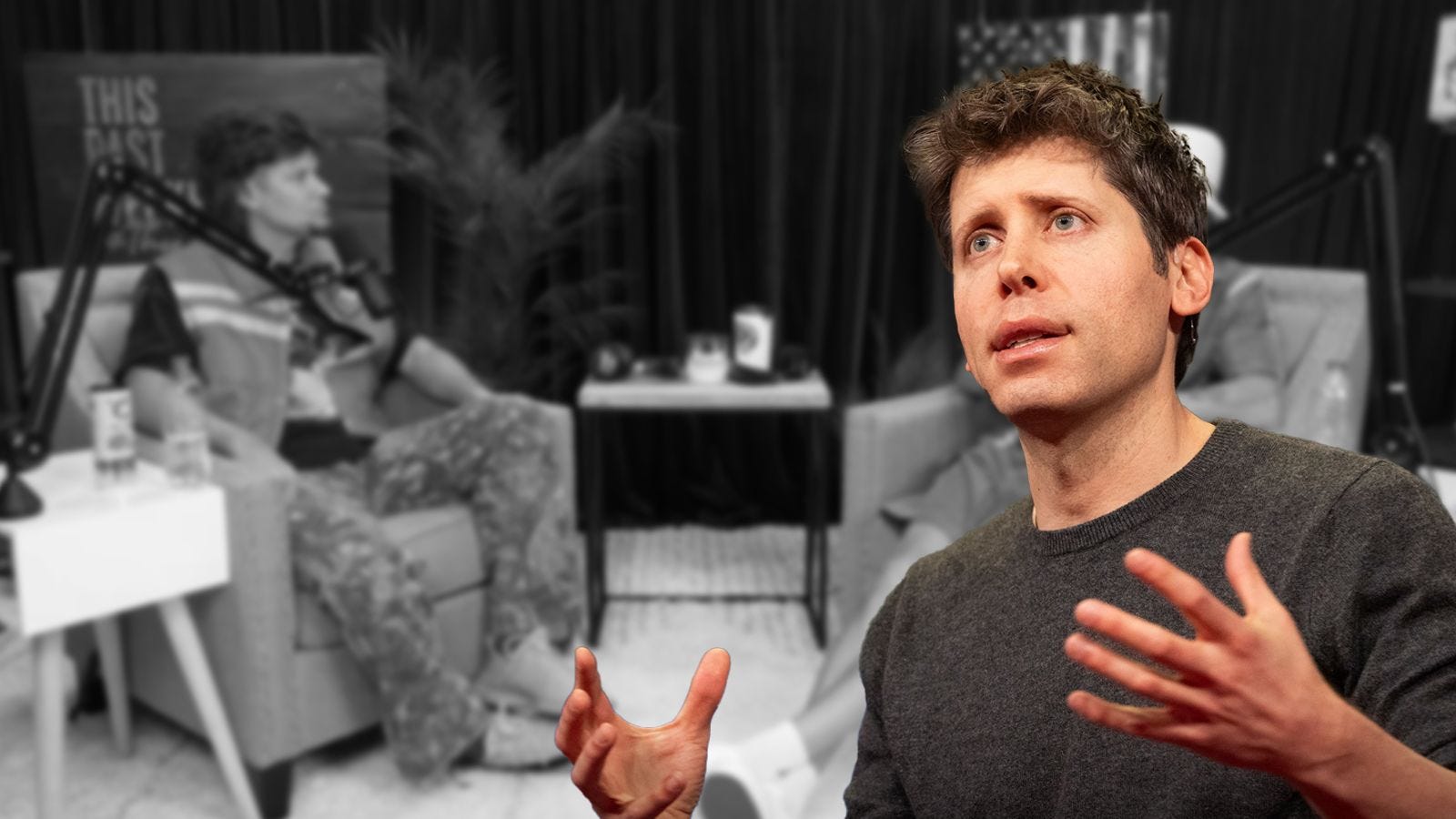
Altman spends a lot of time behind a studio microphone. In the last three years, he’s made over 40 podcast appearances across at least 28 different podcasts, according to data from Podchaser. This count includes appearances on some of the world’s biggest podcasts, including the Lex Fridman Podcast, The Joe Rogan Experience, This Past Weekend w/ Theo Von, the All-In Podcast, Hard Fork by the NYT, Bill Gates’ Unconfuse Me, and How I Built This by NPR.
He also makes regular appearances on CNBC and cable news, though it’s clear that his mind is on YouTube. OpenAI itself recently launched a podcast, and he’s already appeared as one of its guests. In the last month alone, he’s appeared on science YouTuber Cleo Abram’s channel and comedian Theo Von’s chart-topping show, among others. On Theo’s, which draws a younger and less techy audience, he spoke casually. “People talk about the most personal shit in their lives to ChatGPT,” he told Theo. He also made some big promises: “AI will be more profound than fire or electricity in human history.”
Altman told Cleo Abram, who also draws a younger audience, “No child born today will be smarter than AI.” He again struck a casual tone: “If we could go back in time five or ten years and say this thing was coming, we’d be like ‘probably not.’” The appearance, like most he does, touched on some concerns about AI before ending on a positive note: “If I were 22 right now and graduating college, I would feel like the luckiest kid in all of history.” This comes with rapidly increasing unemployment rates for college graduates. (Altman dropped out of Stanford after two years.)
We can’t know for certain why Sam Altman is appearing on so many podcasts, but there’s certainly a strategy behind it. Perhaps it’s to boost perception of our AI future. A Pew Research Center survey from this year found that just 17% of US adults believe AI will have a positive effect on the US over the next 20 years. We recently polled the Roca audience on the same question and found that the majority of readers said AI will have a net negative impact on society.
Matt wrote, “It will absolutely be a net negative. Of course, there will be plenty of breakthroughs, and it wouldn’t be a stretch to say that lives will be saved in ways not possible before. But at what cost? To dilute the experience of the human intellect, and to mute awareness of the natural world is a horrendously high price to pay.”
Harry from Boston wrote, “I am very concerned about the use of AI and tech in general for authoritarian goals, given the Dark Enlightenment-Technocratic ideology among those in control of the government and all the tech companies trying to cozy up. It seems like they’re trying to explore its use for nefarious purposes, particularly mass surveillance and suppression of free expression. I think it will ultimately be a net negative if only the wealthy and powerful are able to weaponize it.”
Perhaps Altman – who strikes an empathetic, solemn, and earnest tone in his podcast interviews – is trying to boost the perception of AI for readers like these. Perhaps he’s also trying to improve his own appearance in the public’s eye, especially with Elon Musk, his former co-founder at OpenAI, having labeled him “Scam Altman” and regularly attacking him. Or perhaps he’s just as boundlessly ambitious as Paul Graham said back in 2008. For someone like that, endless camera time is a powerful tool.
When Bill Gates reflected on his career for Microsoft’s 50th birthday earlier this year, he said the following: “You know, I might tell my younger self, watch out for the government. I was pretty naive about not engaging in Washington, DC, as soon as I should have.”
Maybe Altman has made a similar realization. It’s a lot easier to win in today’s world if you have the internet behind you.
There’s one other theory about Altman’s media appearances. Wall Street Journal reporter Keach Hagey writes in The Optimist, a new biography of Altman, that one of his ex-boyfriends recalled a conversation with Altman from 2016. Altman was fretting about the Hillary-Trump election: “‘If she doesn’t get it, and Trump does, I can’t have that again. I’m gonna do it. I’m gonna run. I think I can win.’”
Altman didn’t run for that office, but he did try to run for another. In 2017, Altman had a team spend six months working with focus groups to refine a policy platform for a run to be the governor of California. He adopted a 10‑point initiative called the United Slate, which addressed issues like housing affordability, Medicare for All, tax reform, and renewable energy. In the end, Altman abandoned the campaign after saying that he was better suited to work on artificial intelligence than serve in public office.
Perhaps one day he’ll change that assessment. If he does, podcast appearances won’t hurt.