

Without Philly in 2020, Trump would have won Pennsylvania with 53% of the vote. With it, he lost with 49%. Biden won Pennsylvania by 80,000 votes – and Philadelphia by 470,000.
Philly – on the opposite side of Pennsylvania from Pittsburgh – is the US’ sixth-largest city, with 1.6M people in its city limits and 6.2M in its metro area. It dwarfs the size of any other city in Pennsylvania, with 5x the population of Pittsburgh. The economy of its metro area equates to about half that of the entire state.
Philly has experienced industrial decline. Unlike Pittsburgh, though, its economy was more diversified and less reliant on a handful of large companies. It lost 25% of its population between 1950 and 2020, although the trend may have since reversed: Between 2010 and 2020, the population rose 5.1%. Several universities are based in Philly, as well as companies like Comcast, Dupont Chemical, and numerous financial firms.
Philly’s population – overwhelmingly educated, black, or union – makes it Republicans’ kryptonite. The city hasn’t had a Republican mayor since 1852. In 2020, Biden won 60% of the vote in Allegheny County, around Pittsburgh. He won 81% in Philadelphia county.
So how were people feeling about this election? What did they care about?

Near a wealthy neighborhood near the trendy South Street, a middle-aged woman and life-long Philly resident said the city is feeling “scared” about the vote.
While everything in the city isn’t great – she blamed the city for treating homeless people “unfairly” by trying to keep them off the streets – she said Philly residents “have no choice” regarding the election: “It’s scary.”
We ran into one of those homeless people less than a block away.
“Fuck Philadelphia,” he said. “It is a bunch of faggots.”
On nearby South Street – a hipster area lined with restaurants, dive bars, record stores, and sex shops – we interviewed a native of inner-city Philly who had worked at one of these places. He had just moved back to Philly after spending four years in Delaware.
“I left for my daughter,” he said, naming a few problems: Violence, schools, “everything.”
“Philly is a slippery slope,” he said, adding that it’s gotten worse: “Just the crime, just the dumb stuff that happens. You can’t really be as comfortable or have as much fun no more.”
Philly has seen a rise in gun violence, which he blamed on kids and parents: “You don’t see many 25, 26-year-olds really being in trouble. It’s the 16, 15-year-olds and their parents who don’t know where they at, don’t care where they at.”
The solution, he said, was “Parents actually taking care of their kids.”
But, he added, it “isn’t as bad as people try to put it out to be. In my opinion, and I tell people this all the time, I’m 28 and I’ve never had a bad run-in with cops, bad run-in with people”
He didn’t care who won the election – as long as it wasn’t Trump.
That man told us that to understand Philly, we needed to interview people in the West and North. The south was mostly white-collar people; north and northeast Philadelphia are “poorer…most dangerous,” he said, while West Philly is “a mix.”
So we headed there to see how inner-city voters felt about the upcoming election.
West Philadelphia’s is rapidly changing because universities are buying up the land and pressing into West and North Philly, which are traditionally black, lower or working-class neighborhoods. To counter the stigma of having facilities in those areas, the city and its universities – the University of Pennsylvania and Drexel, mainly – coined the name “University City.”
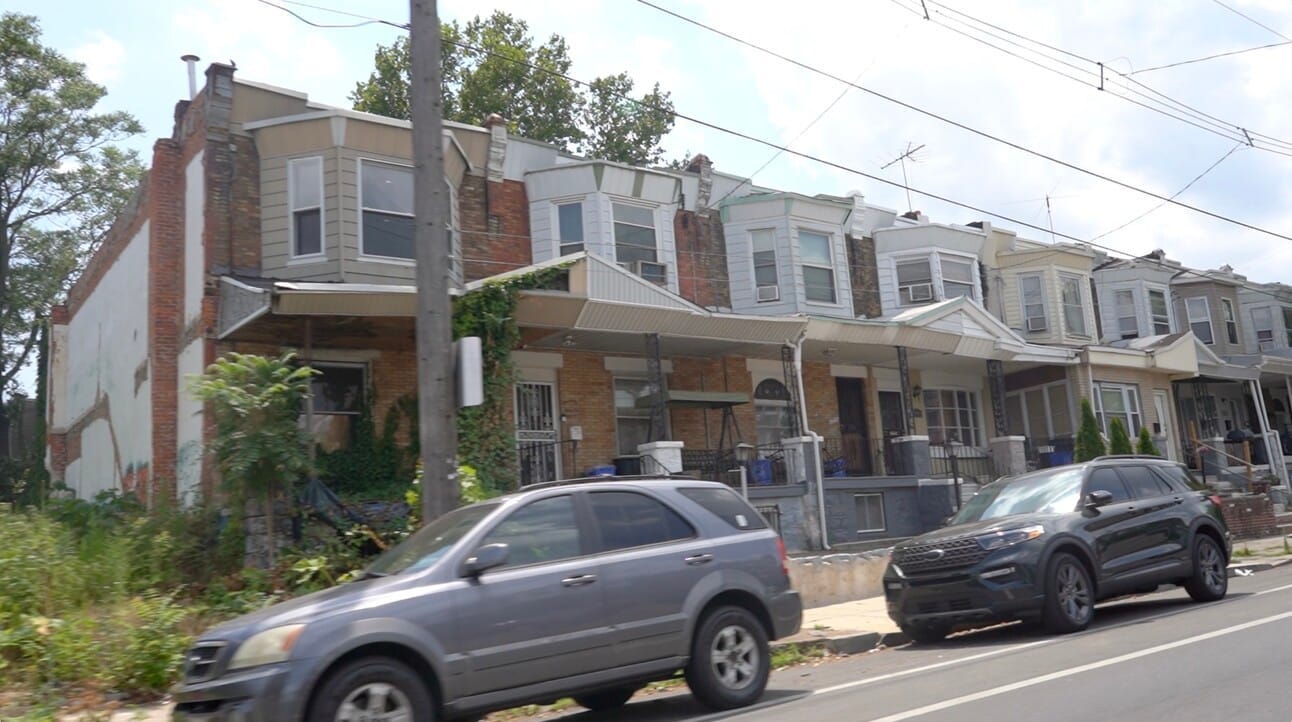
In University City, you have some of the world’s leading research facilities. Keep heading north or west, though, and the reality is different: Neighborhoods of densely packed row houses that suffer from high levels of poverty and crime. These areas provide much of the low-skilled labor – kitchen staff, security guards, etc. – for those universities. Increasingly, students are moving in too.
In West Philly, we met a University City security guard. He gestured to the area around us: “Listen to me, in the next five years, all this gonna be university city property.”
“You think so?”
“I know so,” he said. “It’s written in stone…In the next five years, this property here will double, maybe triple in the next five years. It’s not good for us. The students are going to have all of this.”
He described the area as 70% black, 20% hispanic, and “maybe 10% mix.”
“We all still get along,” he said, chuckling.
“And how about the political breakdown?”
He gestured in each direction: “Democratic. Democratic…all the way around. Democrats all the way around over here.”
“Is that a good thing?”
“It is. Because listen to me: The judicial system just passed a law that said Trump – it’s okay for him to do what we did. And if he get in office and commit murder on somebody, he gonna get away scot-free…The man: He created a riot on the United States Capitol. Why this man is still on this street is beyond me. And he’s running for office. And like I said, if he get in office, all hell gonna... We thought it was bad the first four years. It’s really gonna get bad! It’s gonna be a dictatorship!”
The biggest political issues were “housing and food,” he said. “Before pandemic hit, you had an $850 mortgage, which now is $2,000. We can’t afford that kind of money now with the less jobs there is than there was back then.”
He asked: “Where we gonna get $2,000 a month for a mortgage?”
Another issue was crime: “Crime is bad. It’s bad everywhere.”
“Two blocks up, three blocks over. Seven shot, one dead. Kids…Party going on, kids came to wherever the party was. Jumped out they cars and just opened fire on the party.”
The crime “starts at home. I mean you gotta get control of your children,” he said. “I had strict parents. Taught me right from wrong. But these kids, these days, and their parents – some have a mother and a father. Some being raised by single parents. And some of them can handle it and some of them can’t.”
“When was [the shooting]?”
“Last night.”