

Kensington is Philadelphia’s “open-air drug market,” the city’s “worst neighborhood,” its “zombie street.”
Situated in northeastern Philly, the neighborhood straddles Kensington Avenue. It’s the center of the “tranq” epidemic – named for a tranquilizer that is mixed with fentanyl and causes a user’s skin to rot. In Kensington, fentanyl and tranq are openly consumed and traded on the street. We visited here for a story back in April and found it to be the most disturbing place we had encountered in the US, if not the world.
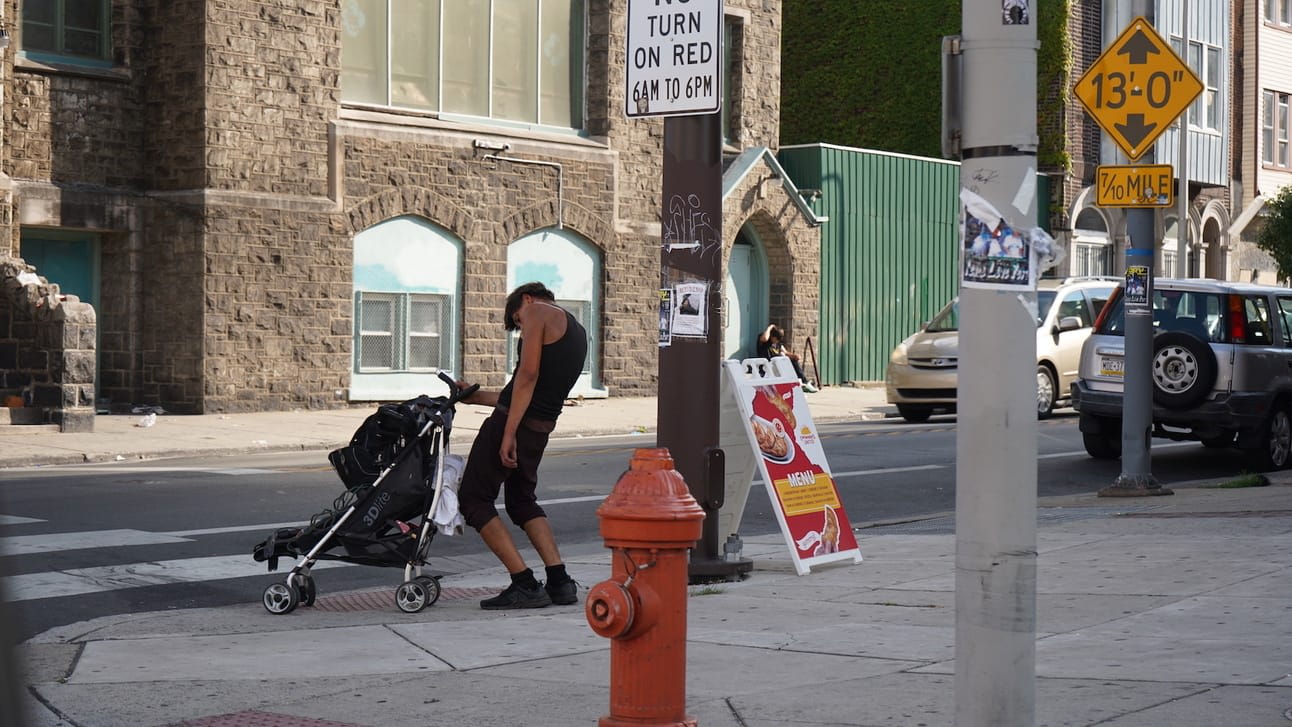
But Kensington wasn’t always this way. In fact, not long ago, it was a place that drew immigrants from around the world. So what went wrong?

As you head north from Fishtown – the “Brooklyn of Philly” – toward Kensington, gourmet ice cream shops and beer halls give way to corner stores and vacant buildings. Nearing Kensington Avenue, the density of people passed out on the street increases: From a steady trickle, there is soon a flood. In some places, you can see more than a dozen people sprawled out on the sidewalks, unable to tell whether they are dead or alive. Many people are swaying in the streets because tranq makes it difficult to stand. Many people look like zombies, hence Kensington’s “Zombie City” nickname.
Kensington wasn’t always like this, as evidenced by the beautiful old stone building of the now-defunct Kensington Trust Company. It was once a neighborhood of manufacturing workers, many of whom were Irish immigrants. Industry left in the 1960s, though, followed by riots in 1968 that precipitated “white flight.” The neglected area became primarily black and Hispanic.
Kensington became a hub of drug dealing that attracted drug users from across the region. Many took to living on the street or in Kensington’s decrepit buildings. The city has been either unwilling or unable to clean up the area. It’s established a safe-injection site and occasionally comes through to power-wash the trash-filled streets.
Kensington’s main street runs below an elevated train line and is packed with drug users and drug dealers. We headed to some back streets and got talking to the locals. Their perspectives were not what we expected.
The first duo we spoke to – men from the Dominican Republic and Puerto Rico – told us that “everyone” around here was on drugs. “It’s dangerous,” they warned. “Don’t go down that way,” referring to the main street.
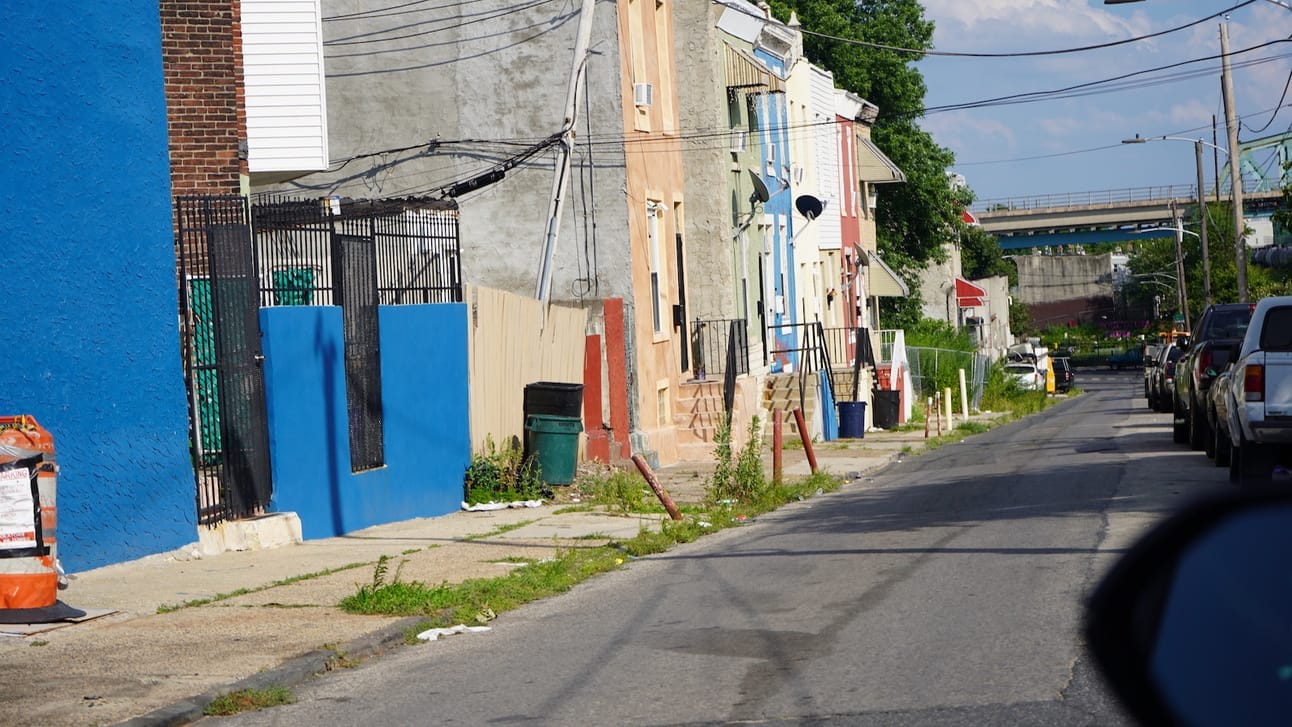
As we chatted with them, a toothless woman approached. She introduced herself as Helen and said she had lived in Kensington all her life.
“There’s always been drugs, but not as bad. Not like pills and this and that.”
“We had a milkman who used to come to our house when I was little,” she continued. “And diapers, sodas, and all that. And they could leave the milk there, nobody would take it.” Now, it would be stolen. She tries to help the community by providing meals to the homeless population.
Across the street, we approached another man. He acknowledged our camera and started talking but then abruptly stopped: “Oh fuck, you were recording me. You know that ain’t safe.”
Once we assured him we weren’t cops or criminals, he settled down.
“I like it here, I grew up here, but it ain’t safe,” he said. “It’s always been bad, but it just got worse. People killing for no reason and all that. Kids dying. Females dying. A lot of females got killed…Everything, everything got worse, money-wise, everything.”
“Fewer jobs?”
“All that. Fiends [drug addicts] wasn’t like this before. I mean, the fiends, like, sleeping all over and none of that.”
“We make sure that sometimes the block is clean,” he said. “Or a lady need help crossing the street. We try to keep – even though it’s surrounded by bad shit – we try to keep it. Respect everybody so everybody can lead a peaceful life.”
We asked if people in the area planned to vote.
“I’m 27. A lot of people my age, I don’t think they want to vote. I wish they would because it’s good. I’m going to vote. I want Trump to win.”
“Why?”
“I feel like Trump did a lot. From when he was in office, he did a lot. It’s like when he left office, things got worse economically. I don’t want to speak about that because I don’t really know much. I don’t want to talk about shit I don’t know…It’s like around the world got worse.”
“Life was better when Trump was here,” he said.” “For example, that shit that happened in Afghanistan, the troops. That shit didn’t happen with Trump.”
He said Philly politicians were doing nothing to help Kensington.
“A lot of n****s don’t want to do this [drugs and crime], but there ain’t no help. Some people ain’t had no choice but to come out here and live out here. There’s a lot of people that’s doing drugs that don’t want to get high. They want a better life, but they don’t get no help.”
Instead of helping people, he said, the politicians were passing stupid policies. He mentioned an effort by the city to crack down on tinted windows.
“Shit like that don’t make sense. You over here worrying about tinted windows. Bitch, worry about really helping people.”
He gestured to tattoos of names on his arms, all people he knew who were murdered.
“Taking tinted windows out, you know what’s going to happen? The homicide rate is going to go up. Because let’s say, this is an example: Let’s say you’re driving past, you take your tinted windows out your car. And – look at my eyes, I got people tatted on me – and you was the one that killed one of my cousins. I’m going to do something to you.”
He concluded: “The homicide rate is going to go up.”
On that grim note, we headed out of the city. Or so we thought.
Driving out of Kensington, we spotted a woman rummaging through the trash. We slowed down to get a shot for our video.
But then we realized the woman wasn’t picking out of the trash – she was picking up the trash.
“Are you cleaning up?” we asked. She proceeded to deliver the most impactful monologue of our entire Pennsylvania trip.
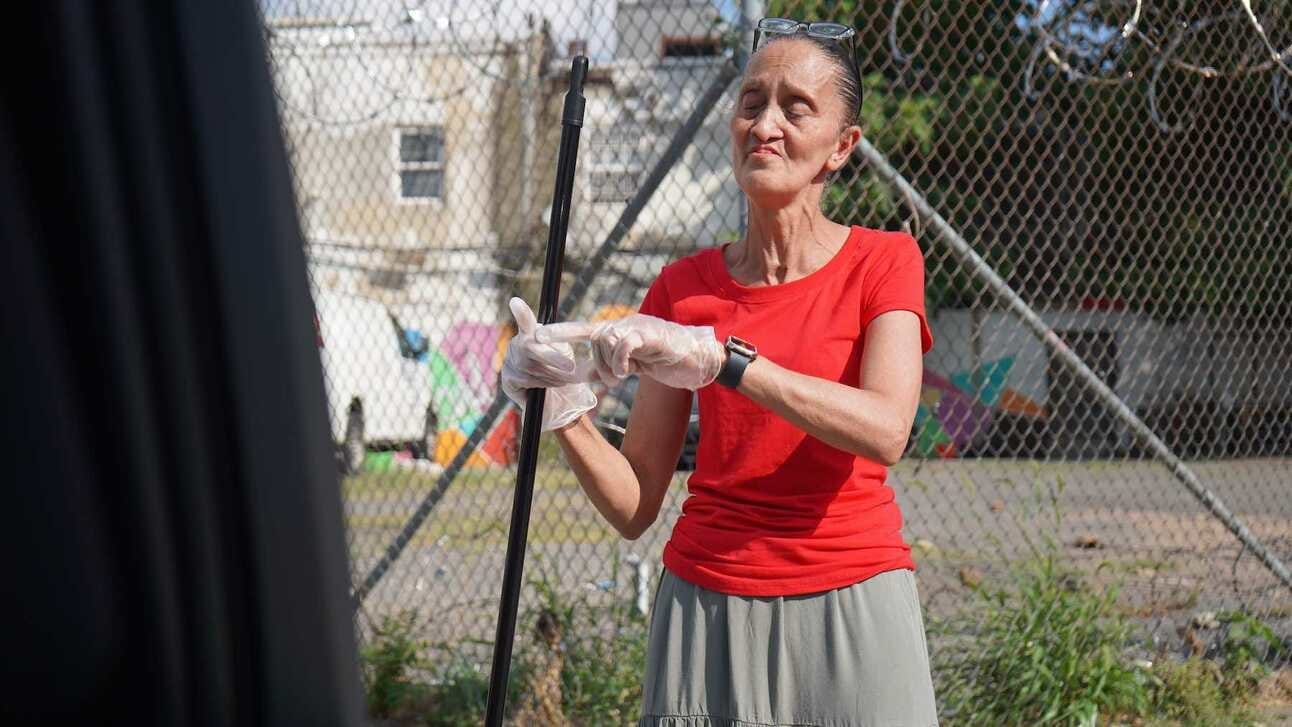
“Yes! I have to! I mean, in order for me to live in my own neighborhood for 30 years, I have to come out here and clean up. So at least when my grandkids come out the house, they’re not faced with all this. Unfortunately. But it is what it is!”
“It’s become a nightmare. The drugs…the homeless. And we’ve come together,” she said, sirens blaring in the background. “We’re all trying to make the city more beautiful, more greener, more cleaner. So as a resident, we have to come out and we have to make a difference.”
The woman introduced herself as Carmen and said she had moved to Kensington from Puerto Rico as an infant.
“Honestly, I think this is one of the communities that comes together as a family. Unfortunately, we’re faced with what’s going on and it’s beyond our mental and emotional stage…I love my city. I love my community. And I refuse to move just because they have come out here and try to downgrade our neighborhood. It’s not happening.”
The people on Kensington Avenue weren’t local, she said. They came from other parts of Pennsylvania, Jersey, and the US. We asked why the city tolerates this.
“It’s not the city,” Carmen said. “Actually, if we as residents come together more, we can try to eliminate what’s going on. But I think that most of the residents, what’s happening is they’re fearful. They fear for their life.”
“I understand many of these drug dealers and many of these people that come out here and sell the drugs, they have no other way of actually getting, maybe they’re getting bread in their household. Maybe this is the only way that they know how to make a fast living or earn that dollar that they need for a soda or whatever. We don’t know what’s behind their mind or what atmosphere or life environment they have come from…So all I can do is try to be part of the solution and not part of the problem.”
As she talked, a pair of Hispanic workers walked by and politely but familiarly greeted Carmen.
“Some of these people that are out here, you know, my heart goes out to them. They have a monkey on their back. They’re trying to get rid of it and they can’t. Yes, there is help. Yes, the city has come together to put many, many resources together. But they’ve thrown themselves to this lifestyle that they can’t seem to get out of.”
“Everyone says ‘Help our city,’ but the help is there. But are you willing to take the help? Are you willing to stand up and say, ‘Wow, let me embrace the opportunity that the city has given us?’ They don’t want to embrace it. They don’t want to embrace the opportunity.”
“Listen, I’ve learned in the midst of the pain, in the midst of the emotional transition that I’ve lived in this community, has made me strong through Jesus Christ. It’s only my God that gives me the strength and gives me the courage…as he lifts me up every day to come out here and be faced with everything that I am facing…He tells me it’s not by your strength or by your might, but it is by mine.”
“So, Philly is my city. And I love Philadelphia. I love Philly. That’s why I refuse to go. Many are just turning their backs on Philly. They’re turning their backs on their hometown just because they can’t take it and so they’re leaving.”
She spoke to the drug users and dealers standing down the street: “You’re not pushing me away. You’re going to go back. I’m staying. I’m here to fight.”