

🌊 The Big Beautiful Strategy
Economists have blasted the bill; Republicans have said they’re missing the point
By Max Frost
When Scott Bessent, a leading hedge fund manager, was campaigning to become President Trump’s treasury secretary, he went on War Room, the podcast of MAGA thought leader Steve Bannon.
Bannon is both an ardent populist and a vocal critic of American deficit spending, warning that excessive debt risks destroying the fabric of American prosperity. In his episode with Bessent, the duo saw eye to eye. In fact, Bessent said he had decided to join Trump’s campaign because of his concerns about the debt:
“I could see that the way the Biden Administration was racking up the debt during their four years…there’s a tipping point where you cannot grow your way out of it,” Bessent said. “There’s a tipping point where you’re too heavy to ever get on the treadmill, you’re gonna have a heart attack.”
With Bannon’s backing, Bessent won the role and became the treasury secretary, tasked with overseeing the US government’s finances.

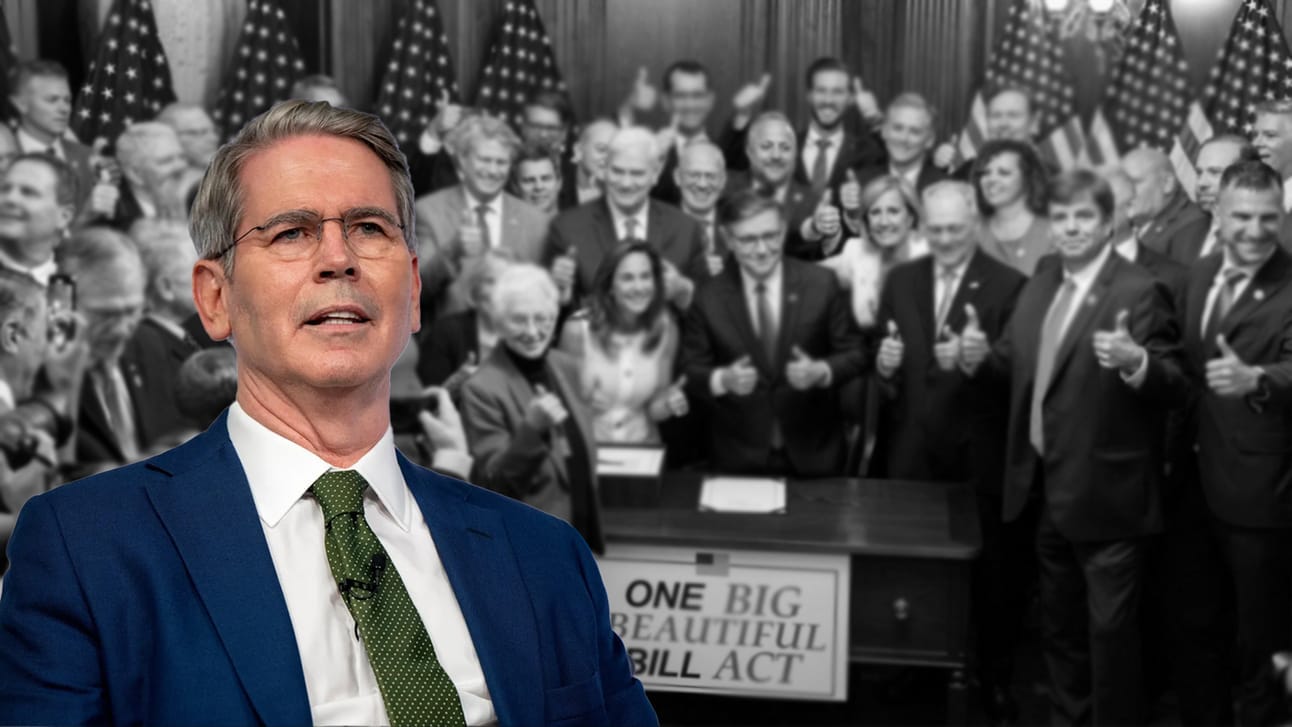
Last week, Bessent returned to War Room as the House was in the act of giving the Big Beautiful Bill Congress’ final approval. On its face, the bill – projected to add $4.1T to the federal debt by 2034 – was the antithesis of why Bessent had moved to Washington, DC.
But Bessent said it wasn’t that simple.
“As I said last year, I was really worried that the economy, the Democrats were tying the economy down,” he began on the podcast appearance. “And the more they did, the more they regulated, we were never going to be able to grow our way out of this.”
He said the solution was to “re-privatize the economy” – and that the Big Beautiful Bill accomplishes that. In today’s deep-dive, we look at what that means.
Bessent – an openly gay colleague of George Soros who formerly helped Al Gore campaign for the Democratic presidential nomination – does not fit the MAGA stereotype. Nevertheless, he’s become one of America’s most influential policymakers.
In his role, he hasn’t just advocated for tweaking the US tax code. Instead, he says that the country needs to rethink the government’s role in the economy in order to let Americans prosper. We’ll first look at Bessent’s logic, then at how that manifests in the Big Beautiful Bill, and finally at the debate around his positions.
Bessent has repeatedly said that, in his view, the significant growth of the federal government in the last two decades has harmed the private sector by diverting talent and capital away from it.
As he recently said:
The private sector, in essence, has been in recession during the Biden years…because it’s been hemmed down by excessive regulation, and this is an opportunity to right-size the federal government and unleash the private sector again, because it’s been hemmed down by excessive regulation, and it’s been crowded out by the government. We are under your direction. We’re re-privatizing the economy.
Bessent frequently refers to “crowding out,” the economic theory that says that government borrowing diverts capital from the private sector by pushing up interest rates and shifting would-be private investment to the government.
Bessent and his supporters, presumably including the president, therefore believe that the first key to grow the economy is to dial back government spending. From there, he believes, the government needs to reduce its debt.
Many economists would say that the key to do so is to increase taxes. Bessent argues the opposite – namely, that it’s futile to try to overcome a US-sized deficit by taxation. Instead, he says, there’s one way out: Growth.
If the economy grows faster than debt, the debt-to-GDP ratio – the most important debt metric – declines. Bessent has said that he and Trump are pursuing a three-pronged approach to achieve this: Using tariffs to bring industry back to the US, thereby stimulating investment and output; deregulation, especially of the energy sector to drive down energy prices and stimulate growth; and cutting of taxes, to boost investment in the private sector and again growth.
Through this combination – cutting spending and then applying tariffs, deregulation, and tax cuts – Bessent has said he believes the US can attain 3% annual growth, thereby getting out of the deficit. And this is what he says the BBB achieves.
“We’re going to have this boom in the country that could be growth like we haven’t seen since post-World War II, since the 1890s, at least back to the 1990s,” he said. “We are making the US the best destination for capital.”
Core to Bessent’s pitch is a component of the BBB that lets businesses expense 100% of costs related to factories and agricultural structures.
“We’re going to have tax certainty, cheap energy, and we are going to deregulate and make it possible for long-term projects, for private sector and the public sector to do what we should be doing in terms of our long-term electricity needs, our fossil fuel needs, for businesses to be able to have great certainty and make long-term investments,” Bessent told Bannon.
Bannon agreed: “You have massive deregulation, deconstruction of the administrative state. All of it comes together in one package.”
Others are less convinced.
The chief US economist at JPMorgan Chase said the bill would do little beyond extend the status quo: “The vast majority of it is a continuation of current policy, and everything else that’s being battled about is, you know, not big numbers…If you’re going to talk about GDP and macro things, you need big numbers to make it matter.”
The Economist, which traditionally preaches free market economics, issued a similar warning:
The bill’s main effect is to extend the tax cuts from Mr Trump’s first term which were due to expire. Republicans paint this as an extension of the status quo. Yet they, like the Democrats before them, ignore the fact that the status quo is unsustainable. Over the past 12 months America’s budget deficit has been an astonishing 6.7% of GDP. If the bill passes, the deficit will remain around that level and the country’s debt-to-gdp ratio will in about two years exceed the 106% reached after the second world war.
The Economist and The Wall Street Journal editorial board, a bastion of even more pro-free-market thought, both wrote that the bill had some positive pro-growth policies, but gave away too much to special interests. The Wall Street Journal, for example, objected to tax cuts for high-earners in blue states, while The Economist criticized keeping the tax rate for income above $500,000 at 37%, rather than letting it return to 39.6%.
Left-leaning publications and commentators across the board also blasted it, alleging that it would inflate the deficit while gutting the welfare net to benefit society’s wealthiest. As The New York Times editorial board wrote:
Once again, Republicans are proposing to reduce taxation. Once again, they are proposing to force the government to borrow more to pay its bills. Once again, federal spending on interest payments would rise – and money spent on interest is money that can’t be spent on other things.
Or as Larry Summers, treasury secretary under President Clinton, wrote:
It will most likely slow growth, risk a financial crisis, exacerbate trade deficits and undermine national security by exhausting the government’s borrowing capacity.
The debate thus boils down to a few perspectives: A pro-business view that sees some of the tax cuts as beneficial but the bill as having too many carve-outs and adding too much to the deficit; a liberal view that sees the bill as giving too much away to businesses and the wealthy while paying for it with cuts to the poor; and a more unorthodox conservative view, held by the president and his allies, that the bill will bring in an era of unparalleled economic growth, lifting people out of poverty, outgrowing the debt, and proving the doubters and critics wrong.
Who is right? The US economy may ride on the answer.