

🌊 The Great Multiculturalism Debate
Both sides of the multiculturalism debate come to life in America’s most diverse neighborhood – Jackson Heights, Queens
By Max Towey
It’s easy to forget the scale of immigration in the United States today, but here’s a stat that puts it into perspective: With 52M foreign-born residents, the US has a greater foreign-born population than the next four closest countries – Germany, Saudi Arabia, the UK, and Egypt – combined.
Driving across the country reminds you of this reality. During our swing state road trip last summer – which, pardon yet another victory lap, led us to correctly predict the outcomes of all seven swing states – we encountered immigrant communities in the unlikeliest of places: A Hmong community in the rural Wisconsin town of Wausau; a Korean neighborhood in Duluth, Georgia; and an Arab-majority city in Dearborn, Michigan. It was there that we saw a stunning image of multiculturalism: Girls wearing hijabs under their cowboy hats in the student section of a high school football game.
In western and central Pennsylvania, the reality of immigration was fainter, though still palpable. In every steel town, we saw “ethnic clubs,” like the Serb Club or Slovak Club. The Poles had their own church, community center, and neighborhood, while the Italians had theirs. In one of our more memorable meals, we met the owner of Dabrowski’s, a Polish diner in Erie, PA. At one point, she (affectionately, I hope) told me to “shut the f*** up!” after I had evidently asked too many questions. Her family had run that diner since she was a little girl.
These trips revealed, in many ways, the beauty of immigration. After all, as we learned in grade school, immigrants built this country. And despite early prejudices, which seemingly every new group endured, assimilation followed. Just last week, we toured Little Italy in New York City with a historian who showed us newspaper clippings from the early 20th century that revealed jaw-dropping instances of anti-Italian discrimination. For decades, Italian-Americans had to fill in their own bubble on the US Census, the historian told us. But now it’s hard to imagine a more American night than watching The Godfather with a large pizza in front of you while a Joe DiMaggio Yankees jersey and Frank Sinatra poster hang on the wall in the back.
With this in mind, multiculturalism seems to be a beautiful thing, and assimilation seems inevitable. But there’s an alternative viewpoint to mass migration and multiculturalism, and one that we saw come to life in Jackson Heights, Queens – the country’s most diverse neighborhood.

The anti-multiculturalism and -mass migration viewpoint hinges on two core beliefs: 1) The US has 330M people and a shortage of housing and quality jobs, both of which migrants exacerbate for current residents; 2) Immigrants used to come primarily from Europe, but today they come from cultures that don’t share core Western values and don’t mix as well with America’s founding principles, no matter how nice the people from those groups seem at an individual level.
We heard variations of these sentiments all over the country. In rural Pennsylvania, voters told us that illegal immigrants push down wages by taking blue-collar jobs at criminally low pay, enriching companies while hurting US citizens. In the Bronx, voters lamented that migrants got debit cards to swipe at grocery stores and hotel rooms to sleep in while they have to work difficult or multiple jobs to barely scrape by. In more candid conversations, others expressed that migrant-heavy communities don’t “feel” or “look” American, echoing the words of President Obama in his book The Audacity of Hope: “When I’m forced to use a translator to communicate with the guy fixing my car, I feel a certain frustration.” For all these reasons and more, many feel our country is full.
This fear of mass migration, by the way, is nothing new. Alexander Hamilton, an immigrant himself, wrote this in The New York Evening Post in 1802:
The United States have already felt the evils of incorporating a large number of foreigners into their national mass; it has served very much to divide the community and to distract our councils, by promoting in different classes different predilections in favor of particular foreign nations, and antipathies against others. It has been often likely to compromit the interests of our own country in favor of another.
We saw the complexities of the multiculturalism debate brought to life during our trip to Jackson Heights. The neighborhood, abutting New York City’s LaGuardia Airport, has 160 languages spoken within its 300 acres and 100,000 people. Over 60% of its residents are foreign-born, and its main strip, Roosevelt Avenue, smells of curry on one block, empanadas on the next, and kebabs after that.
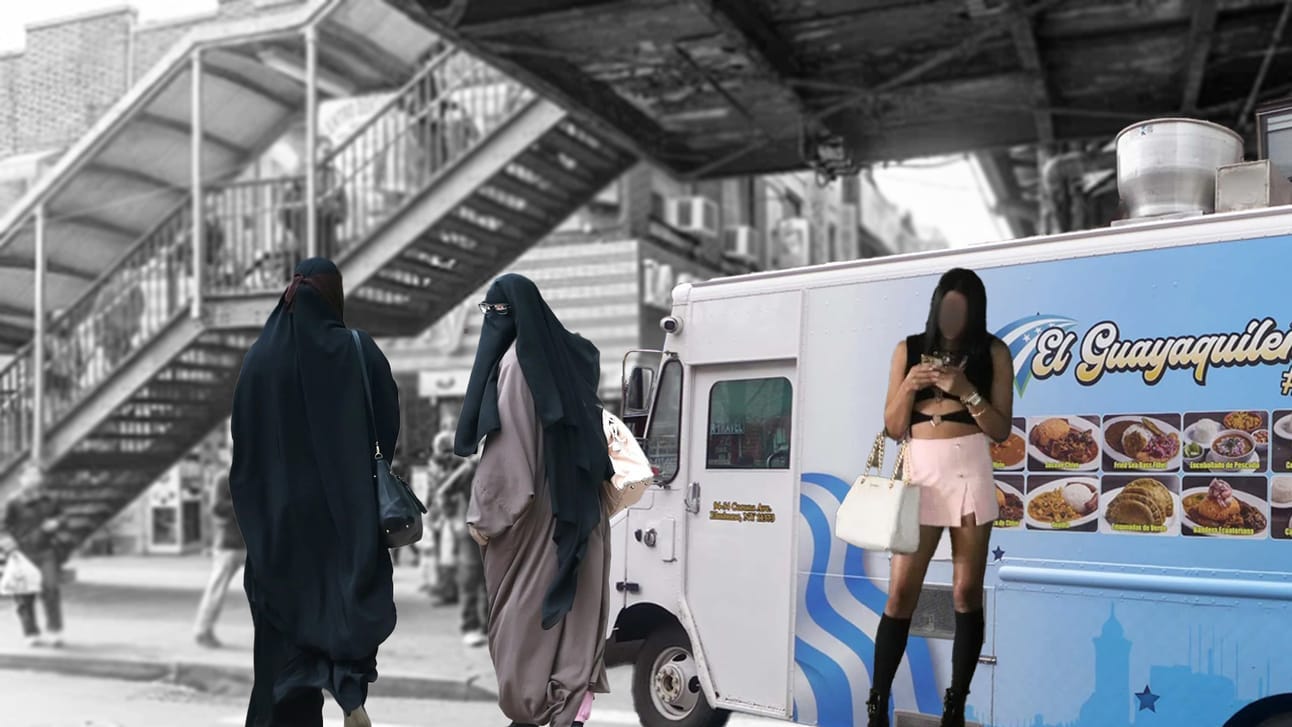
One longtime resident remarked, “I like watching the mothers pick up their kids from school cause there’d be one mother with a tight skirt and high-heeled platform shoes, and another with a burqa and a hood. And their kids would be going to the same school.” Another longtime resident told us, “My idea of what looks good and beautiful have changed. Because when I grew up it was all Irish and Italians, but now I appreciate the different looks and shapes and colors.”
The history of Jackson Heights reflects the shifts in US immigration overall. With the passage of the highly consequential but little-known Immigration and Nationality Act of 1965, the face of immigrants in the US changed overnight. Until then, the country admitted immigrants based on a quota system that brought in people in proportion to those who were already here. Essentially, the US was made up of Europeans, so it let in Europeans. But the 1965 Act removed those quotas, and waves of Latin American and Asian immigrants began to arrive.
Prior to 1965, two-thirds of US immigrants were European; today, just one-tenth are. During this time, Jackson Heights went from being a white working-class neighborhood to one populated by Bangladeshi, Ecuadorian, Pakistani, Venezuelan, Colombian, and Mexican immigrants, among others.
On the one hand, Jackson Heights is a glimmering portrait of multiculturalism. The people we met could not have been nicer, more family-oriented, and more grateful to be in America. The first person we talked to, a Palestinian shopkeeper, proudly declared that America was “the best country in the world… by far.” One of his kids had just become a doctor. Everyone – from the Venezuelan asylees to the Nepalese delivery workers – expressed a similar sentiment.
In Little Bangladesh, a young girl named Samiya told us that she had arrived in the US just six months prior. She was painting henna on another girl’s hand and said it was the first day of running her henna stand, her own business. She invited me to be next – and said her dream was to be a physicist. While she misses home, her community of Muslim Bangladeshis has created a sense of a new home. She said she loves America and fully understands why her parents chose to move here. She talked about her “white teachers” at school and said she’s playing basketball at school. Her favorite player is Stephen Curry.
There were similar levels of enthusiasm, gratitude, and hard work in the adjacent Hispanic section of Jackson Heights. We met Ecuadorians, Venezuelans, Colombians, Mexicans, Nicaraguans, and Hondurans who endured unthinkable obstacles to coming to the US. Many crossed the treacherous Darién Gap, navigated the cartel-infested Mexican deserts, and arrived in Queens against all odds. They all said they were thrilled to be in the US, and given the arduousness of their journeys and difficulty of their lives here, it’s unlikely they were putting on airs.
But that was just one side of Jackson Heights.
Jackson Heights’ history doesn’t reflect a multicultural utopia.
In the 1970s and 1980s, Jackson Heights became the American hub for Colombian drug cartels. In 1978 alone, there were 27 killings linked to the cocaine trade, as the neighborhood’s Colombian community provided cover for cartel operations and turned Jackson Heights into New York City’s money-laundering capital. That year, the founder and publisher of The Jackson Heights Record told the NYT, “It used to be a very refined section with a very fine class of people. Now it’s deteriorating, that’s the right word for it.”
Hundreds of millions, possibly billions, of dollars in cash and drugs flowed through the area over the next decade. The Drug Enforcement Administration estimated that 90% of New York-area money laundering cases traced back to Jackson Heights. In 1988, a cartel killed a rookie police officer. In 1992, it killed the editor-in-chief of New York City’s largest Spanish-language paper, the first time a cartel had killed a journalist on American soil.
A police crackdown ensued, and crime fell. In recent years, though, the situation has deteriorated again.
Roosevelt Avenue absorbed a large number of illegal immigrants and, in doing so, became an American hub for Tren de Aragua, the Venezuelan gang. Pimps and prostitutes now work openly on the street, which is lined with brothels. My co-founder, Max Frost, spent four months living in the neighborhood last year and recalled when pimps took over his block. Each day, he walked to the subway past a group of women offering “massage, massage.” His roommate, a Brazilian immigrant, couldn’t believe what had happened to her neighborhood. Looking at a crime map would reveal a frightening number of muggings. Mayor Eric Adams has announced a task force to clean up life on Roosevelt Avenue, but residents told us the crime continues.
Beyond the crime, others hold cultural concerns, particularly about the conservative Muslim population in the neighborhood’s Asian section. Many Bangladeshi and Pakistani women go about in full-body abayas and niqabs, which reveal only the eyes.
The fact is that for each woman wearing a niqab is a young girl opening her own business and talking about Steph Curry and becoming a physicist. These debates have gone on for generations.
As we left Jackson Heights on the M train, the sun was setting over the Manhattan skyline – a modern wonder built by generations of immigrants. Yet between those buildings was a jam-packed island, a true concrete jungle where people fight to move into year after year and which is becoming ever less affordable.
So are the debates going on today the same as those with the Italians 100 years ago? Or have times actually changed? The answer may lie in Jackson Heights.