

16 years ago, Anthropic CEO Dario Amodei, then a grad student at Princeton, wrote a blog post for the “charity evaluator” website GiveWell. In it, he described himself as “interested, very broadly, in what I can do to make the world a better place.” He went on to explain why he chose to donate to a charity focused on malaria vaccination, rather than another focused on preventing tuberculosis, including a calculation of how many babies an adult life is worth:
I feel that adults are capable of deeper and more meaningful experiences than are infants, and also deeper connections with other people, so an adult death seems worse to me than an infant death (though both are of course bad). Trying to quantify exactly how much worse is very subjective and can also seem calculating (“how many babies would you kill to save an adult?”), but…I’d say that I think an adult death is perhaps 2 or 3 times worse than an infant’s death.

To most of us, a statement involving hypothetically killing babies to save an adult, even when assured that “both are of course bad,” is a bit eyebrow-raising. (To say the least.) But on GiveWell, a website dedicated to the controversial moral philosophy known as “effective altruism,” it fit right in; most of the comments praised the essay, with GiveWell co-founder Holden Karnofsky even adding statistics to bolster Amodei’s point.
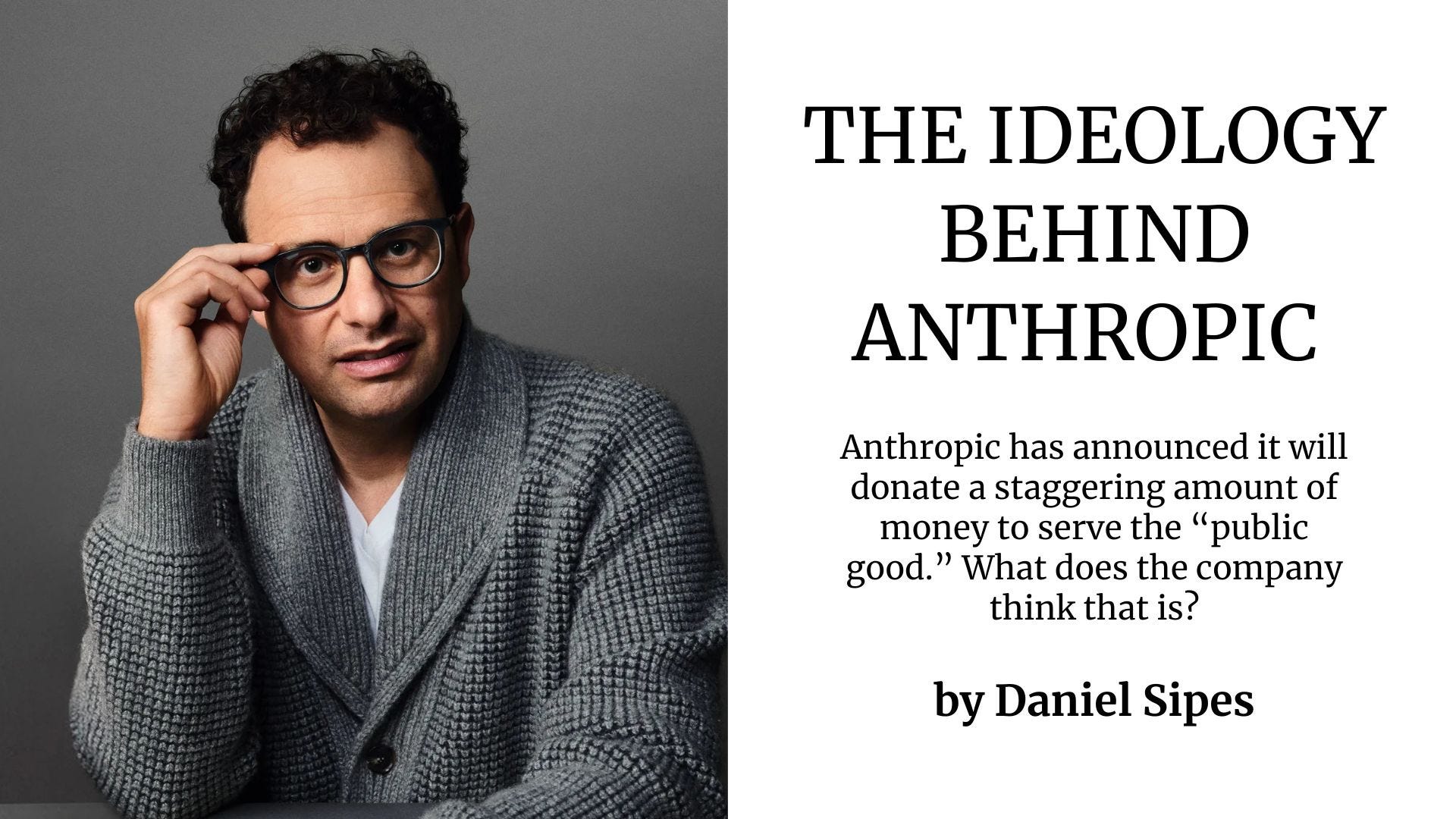
Cut to today, and Karnofsky is working on AI safety for Anthropic, which last week announced a plan to commit 5% of its shares – worth $100B if the company’s upcoming IPO goes as planned – to the newly created “Anthropic Public Benefit Fund.” To put that in context, Americans currently give about $600B to charity each year in total. That means we might see a 16% increase in America’s charity funding, all driven by one company and all going toward what that company deems the “public good.”
So how does Anthropic define that term? I investigate below.