

🌊 Tiananmen Square 2.0?
What the recent protests in Iran have in common with those at Tiananmen Square

Correction: A prior version of this article incorrectly identified the deceased Chinese leader as Deng Xiaoping. It was Hu Yaobang, and the story has been updated to reflect that.
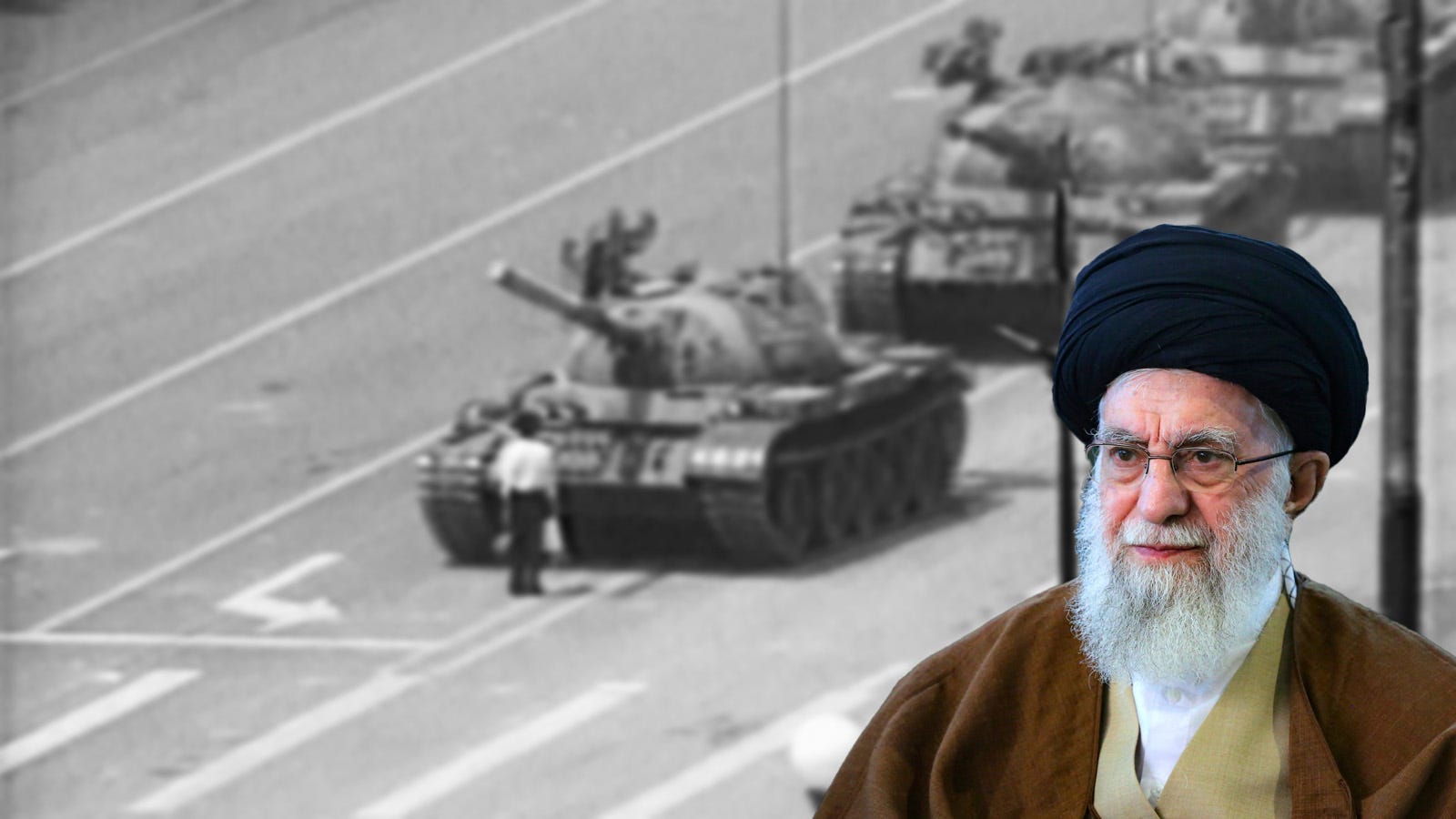
On the morning of June 5, 1989, an AP photographer captured a video of a lone man standing in front of 18 tanks on the Avenue of Eternal Peace on Beijing’s Tiananmen Square.
As the lead tank turns to try to get past him, he moves over and steps in front of them. When the lead tank stops, the man climbs on top and appears to speak to the driver before going back in front of the tank. Two men eventually come and take the man away. The “Tank Man’s” name and fate are still unknown.
The catalyst for the scene was the death of Hu Yaobang, a popular leader who had ditched decades of hard-line Maoist communism in favor of pro-market economic reforms. A staunch opponent of corruption and nepotism, he sought to transition the country away from its radical ideology toward one that would bring more prosperity to his country. Hu was a moderate in an otherwise radical party.
As people in the country mourned – often together in large gatherings – students in the capital used the event as an opportunity to express their growing frustration over high inflation and government corruption. Soon, the airing of grievances turned to genuine calls for political and economic reform. As the calls grew louder and spread to cities across the country over the course of seven weeks, the government began to realize that the protests wouldn’t go away on their own.
From there, things spiraled out of control.
In late May 1989, the government declared martial law in the capital. On the evening of June 3, the protests hadn’t gone away, but the government had had enough and ordered the army to end the demonstrations once and for all. Soldiers fired at protesters attempting to clear the streets. They used tanks, armored personnel carriers, and tear gas to push the protesters to one of the city’s squares, where they continued to fire at and run over the protesters – mostly students – who fought back with Molotovs and rocks.
Before the sun broke on the morning of June 4, the square was cleared. While some protesters escaped, soldiers killed many others, and in the immediate aftermath, the government imprisoned, executed, or blacklisted just about everyone involved. When all was said and done, the crackdown left hundreds, if not thousands, of protesters dead. The government’s official account is 241, though we’ll likely never know the real toll as the exact numbers vary wildly.
The Tiananmen Square protests of 1989 – the biggest challenge to the Chinese government and the Chinese Communist Party (CCP) in modern history – marked a crossroads, forcing the Party to choose between caving into the demands of the protestors or hardline suppression.
So what exactly happened at Tiananmen Square? What happened next? And is Iran facing its own Tiananmen Square moment? That’s the subject of today’s deep-dive.
Keep reading with a 7-day free trial
Subscribe to RocaNews to keep reading this post and get 7 days of free access to the full post archives.