

🌊 Trump’s Plot to Control Brazil
Can Trump help an allied former leader beat a life in jail?
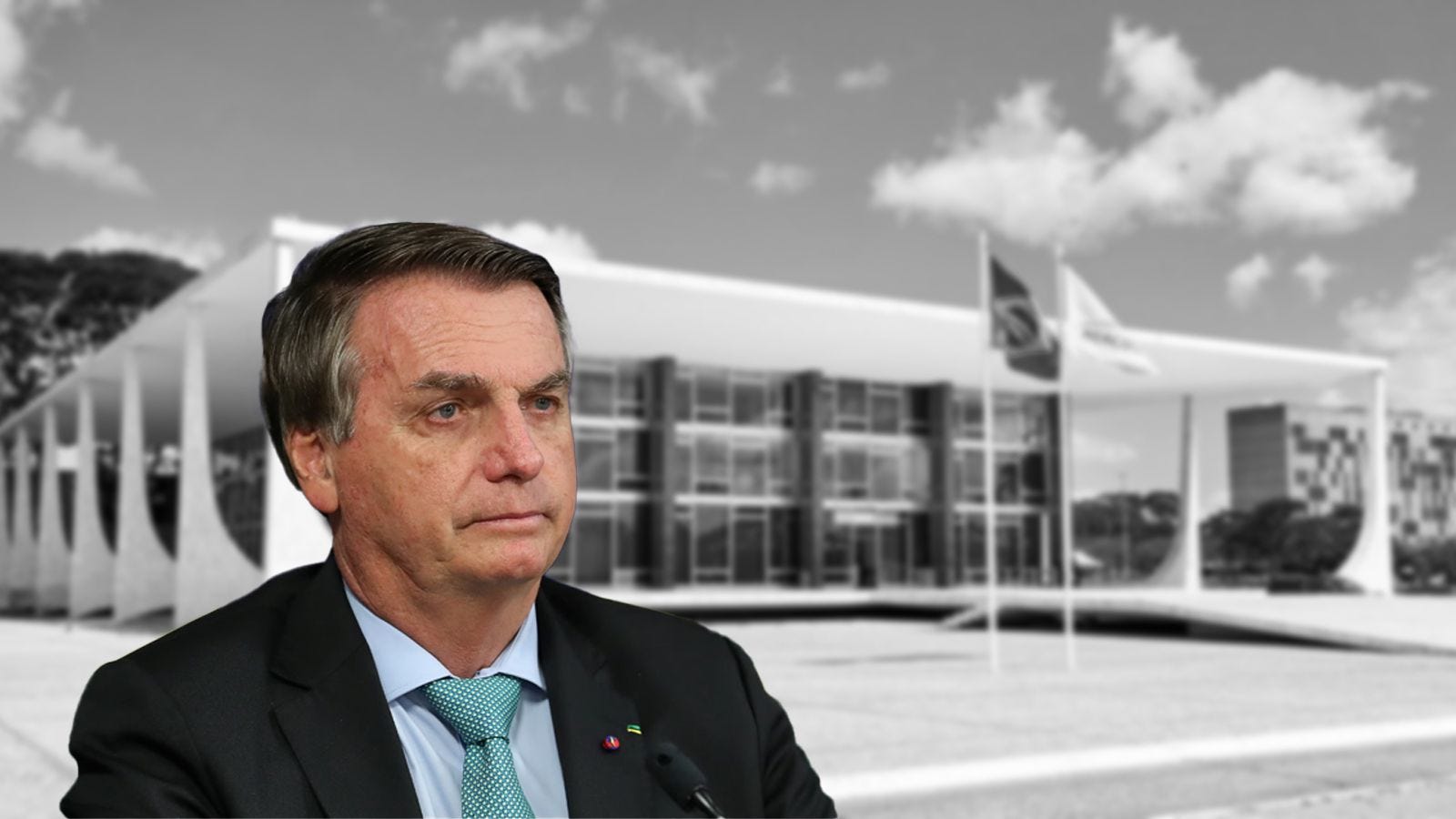
By Max Frost
Last week, President Trump announced a shock 50% tariff on Brazil, citing a “witch hunt” against the country’s former president, Jair Bolsonaro. Yet the situation is bigger than any one man: In today’s deep-dive, we explore what Trump actually wants from Brazil and how the tariffs relate to the foreign policy idea of “hemispheric control.”

Earlier this month, Brazil was hosting the annual summit of BRICS, a bloc whose core members are Brazil, Russia, India, China, and South Africa. MAGA commentators spent the months ahead of the meeting warning that the bloc was seeking to undermine the US-led economic order. Specifically, they warned, BRICS wanted to replace the dollar.
Those raising the alarm included Steve Bannon, a key Trump strategist who hosts the influential “War Room” podcast.
To Bannon, BRICS is not just another group of economies, and Brazil is not just another country. Rather, he described BRICS as a China-led tool for undermining American power – and Brazil as the linchpin to that strategy in the Americas.
This idea goes back two centuries, to when President James Monroe declared that the US would consider any foreign intervention in the politics of the Americas as a potentially hostile act. This precept – the Monroe Doctrine – guided American foreign policy in the years to come, particularly in the 1900s.
Fast forward to 2025: Bannon and other MAGA minds say the US has lost this privileged position, pointing to anti-American policies in places like Brazil and Venezuela. In recent years, Brazil has expressed support for establishing a BRICS currency to replace the dollar, Venezuela’s government has facilitated drug trafficking into the US, and Chinese companies have operated part of the Panama Canal.
Trump-aligned thinkers, from Bannon to Tucker Carlson, have described this as a result of the US overstretching itself in Europe and the Middle East. The solution is to refocus on the Western Hemisphere to shore up the US’ global position and establish “hemispheric control.”
Hemispheric control envisions US-aligned countries running from the Arctic Circle to Antarctica, from Greenland to Argentina. In the north, the focus is on shoring up Arctic defenses so that melting ice caps don’t leave North America vulnerable to Chinese and Russian ships, which will have a much easier path as ice melts. Concern about this situation has helped motivate Trump’s threats to annex Greenland and turn Canada into the 51st state. (Although it’s not just Republicans who have advanced these ideas: The Biden Administration also expressed concerns about Canadian vulnerabilities in the Arctic and pressured Canada to improve its defense capabilities there.)
Arctic defense is the northern component of hemispheric control. The southern component is having pro-American leaders. As Bannon laid out to Canada’s CBC earlier this year: “President Trump gets a partnership with Greenland, secures the Panama Canal, and makes sure that they’re robust democracies like Bolsonaro in Brazil and Milei in Argentina. Then we’ve almost completed hemispheric defense.”
Jair Bolsonaro is core to this strategy. The so-called “Trump of the Tropics,” Bolsonaro is a right-wing populist who built a massive base by leveraging social media to attack Brazil’s political and social elites. As president from 2019 to 2022, he closely linked his movement to Trump’s in the US. Crucial to this was his son Eduardo, who cultivated close ties with Bannon and became the Latin American representative of Bannon’s nationalist organization.
Bolsonaro firmly aligned Brazil with the US and Trump in particular. Ahead of Brazil’s 2022 presidential election, though, polls showed Bolsonaro trailing the left-wing Lula. In this period, Eduardo visited Mar-a-Lago frequently and consulted Bannon, who in 2020 had told Trump never to concede defeat in the election and became one of the most vocal proponents of the “stolen” election theory.
In 2022, a similar situation played out in Brazil.
That July, Bolsonaro convened a group of ambassadors at his residence and warned them about the legitimacy of Brazil’s electoral system and threats to voting machines. Three months later, though, Bolsonaro performed better than expected in a first-round vote, setting up a run-off against Lula.
Lula won that vote 50.9-49.1. As in the US, Bolsonaro’s supporters alleged fraud, and his supporters responded by setting up protests and camps in the capital, Brasilia. On January 8, a week after Lula assumed office, Bolsonaro’s supporters stormed federal buildings in Brasilia, including the court and presidential palace.
Bannon cheered them on from the US, calling them “Brazilian freedom fighters” and directly comparing their behavior to that of the January 6 rioters. Both groups, he said, were trying to stop an election from being “stolen” by the left. Yet the protesters failed to stop Lula from taking office.
Bolsonaro followed that drama by going into exile in Florida. Brazilian authorities, meanwhile, opened a series of investigations into his activities.
In 2023, Brazil’s top court voted 7-2 to ban Bolsonaro from running until 2030, thereby making him ineligible for the 2026 presidential election. The ruling was based on the meeting he had with ambassadors in July 2022, where he cast doubt on the validity of Brazil’s upcoming election results. Critics called it an anti-democratic overreach by Brazil’s courts.
A year later, prosecutors charged him with fraudulently obtaining a Covid vaccination card. Four months after that, they charged him with failing to declare diamonds gifted to him by the Saudi leader when he was president.
This year, prosecutors charged Bolsonaro with a coup attempt and related crimes, alleging that following the 2022 election, he had planned to declare an emergency, deploy troops, overturn the election results, and stay in power. Prosecutors have said that Bolsonaro and 33 co-conspirators also plotted to kill Lula and Bolsonaro’s main foe on Brazil’s Supreme Court.
The 68-year-old is now facing these charges. If convicted, he faces up to 40 years in prison.
The situation puts Bolsonaro at the convergence of several MAGA priorities: He’s a staunchly conservative pro-Trump leader considered to be a bulwark against Chinese and leftist influence in the Americas. Add to this Trump’s identification with Bolsonaro’s plight – Trump said last week that what’s happening to Bolsonaro “happened to me, times 10” – and the product is last week’s 50% tariff on Brazil.
Brazilian officials and many others have expressed anger and shock at Trump’s use of tariffs to interfere in the case against Bolsonaro. Analysts say the situation has led to a rallying around the flag in Brazil, with even some Lula critics defending the government against Trump’s use of tariffs.
Yet other Brazilian politicians have accused Lula of stupidly antagonizing Trump, leaving Brazil to face the consequences, and many on the MAGA right have celebrated Trump’s use of raw American power to advance its interests.
As Steve Bannon said last week, “If you drop the trial and drop the charges, the tariffs go away…It’s MAGA, baby…It’s a brave new world.”