

“I’m 30 years old. Not one of my friends has children. Zero. None’s having kids. Do you know how hard you need to abuse a mammal to make them not have children?”
I first came across Connor Leahy through his mega-viral rant on the linkage between technology and declining birth rates. He argues that young people aren’t having kids because technology is making it more difficult to mate. That starts with the “panopticon.”
So there’s a thing that happens especially with younger generations… There’s a huge problem where they don’t dance. They go to clubs, and they don’t dance. Why is this? Because they get recorded. If you’re an 18 year old kid and you go to a club, you get recorded. If you approach a girl and you mess it up, you get recorded. Everything is a panopticon now.
Then he turned his attention to dating apps: “Do you know what dating app algorithms do? They don’t optimize you to meet the love of your life. They optimize to keep you coming back to the app.”
And finally he gets to his larger point:
I think there’s a deep thing where we as a society has not dealt with the fact that we have to steward technology responsibly. We have treated technology as a wild west. Oh, just sell all of our younger generation’s dating lives for profit… we just let technology rip. If you let technology rip… there will be freedom and Democracy and economic growth. Where is that?
Leahy’s rant resonated. On Instagram, there are multiple clips of it with over 1M likes. Many commenters felt he neglected the financial and ideological reasons why young people aren’t having kids in developed countries, which is a critique Connor Leahy conceded in my interview with him. But his main point hit: Tech companies may not all have the best interests of the human race in mind.
While Leahy is not a fertility expert, he is an AI expert. He reverse-engineered GPT-2 – one of OpenAI’s early models – in his college dorm room in Germany in 2019 as a computer science student. He then founded open-source AI company EleutherAI and now works as an AI safety advocate.
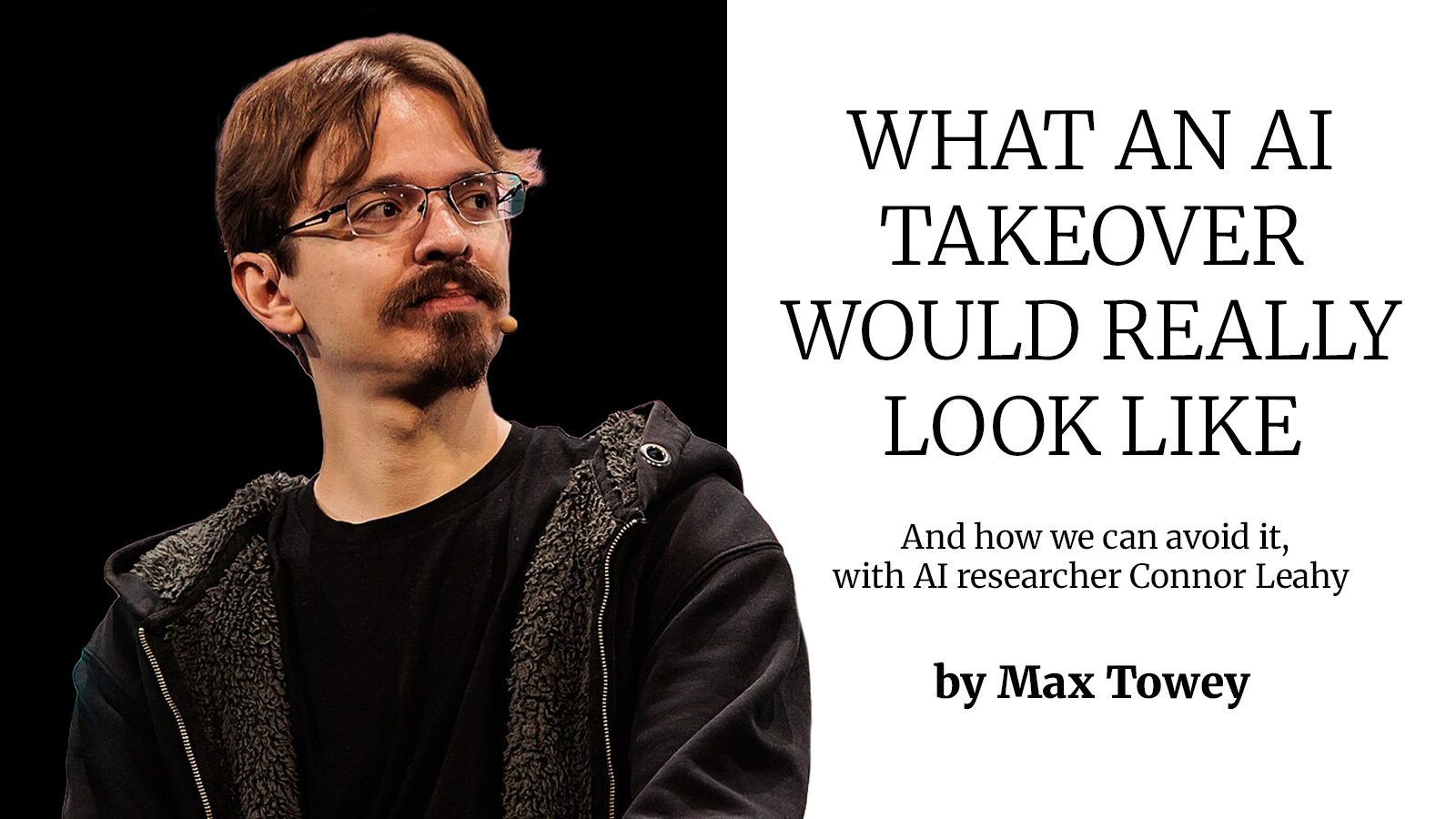
He’s the US executive director of ControlAI, a nonprofit that lobbies governments to regulate the AI industry. The job puts him in Washington, DC, where he spends his weeks telling members of Congress the same thing he told me: That the top AI labs are racing to build “superintelligence” – AI that can outcompete humans at everything – and that none of them knows how to control it. So I asked him the question in the headline: What would an AI takeover actually look like?

Our conversation, condensed and edited for clarity, is below.