

Since Maduro’s capture, The New York Times has published at least ten op-eds on the subject. These are their titles:
“Trump’s Attack on Venezuela Is Illegal and Unwise”
“To Trump, on Venezuela: You Break It, You Own It”
“This Is What Venezuelans Really Want”
“‘This Is Purely a War of Choice’”
“Maduro’s Ouster Plays Right Into Putin’s Hands”
“‘Arrogant, Dangerous and Illegal’: Trump’s Motives for the Attack on Venezuela”
“This Isn’t Regime Change. It’s Extortion.”
“Trump Is Unleashing Forces Beyond His Control”
“The Danger of Trump’s Flamboyant Violence”
“Who Wins From Trump’s Venezuela Oil Gambit? Not Regular Americans.”
We understand that the NYT opinion page – including its conservatives Ross Douthat and Bret Stephens – is not known for cheerleading Trump. But seriously? Not a single positive piece? Not one that’s even ambiguous?
Initial polls from Reuters and the WaPo – not exactly MAGA rags themselves – suggest that public opinion is almost perfectly split on the issue. So how can the NYT be one-sided?
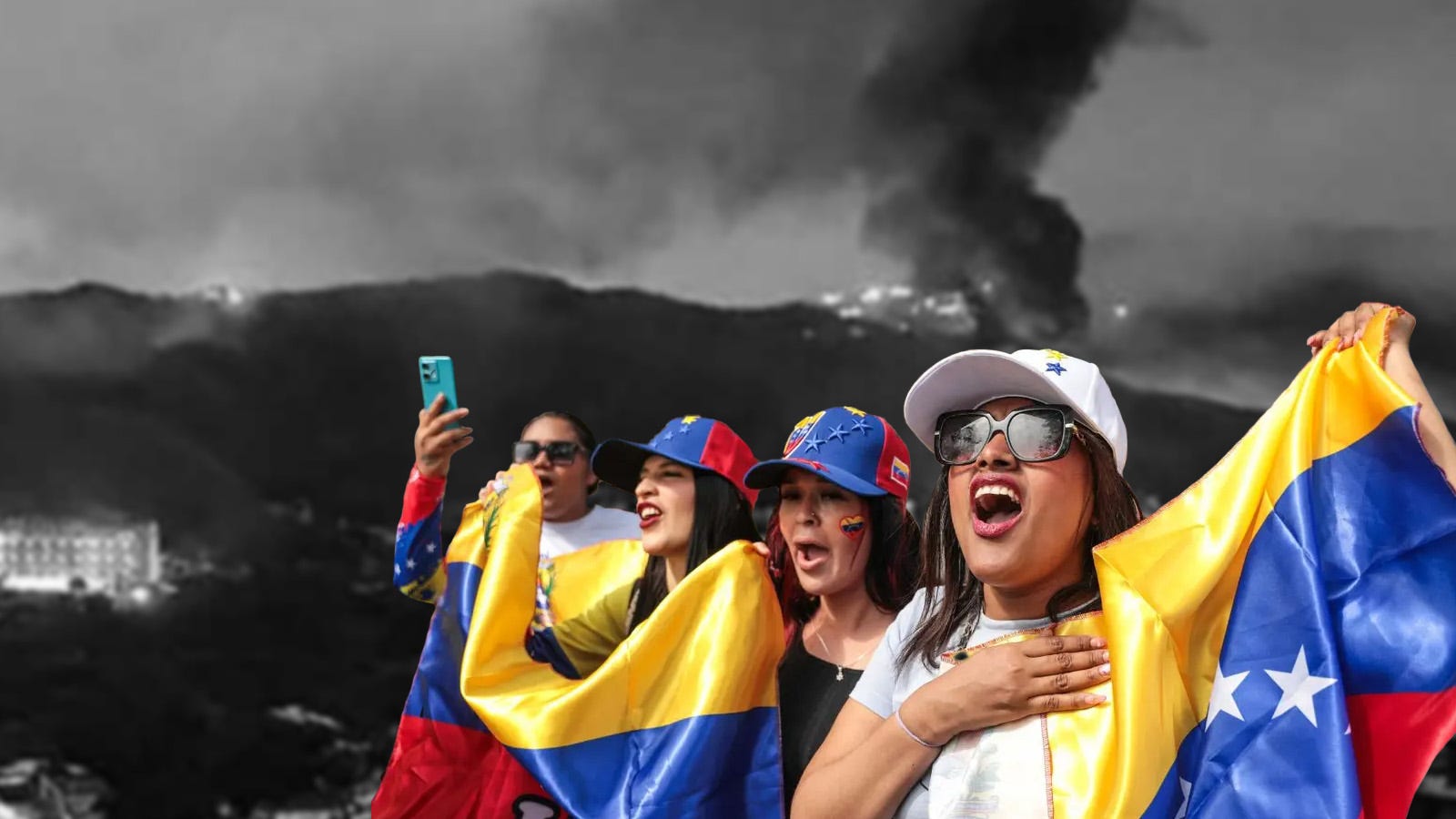
On an issue like this, which has affected so many people that we ourselves know and have interviewed, we needed to take a break from the rants of op-ed writers like Thomas Friedman. Instead, we wanted to ask Venezuelans from around the world what they think of the move.
Thankfully, Venezuelans in the Roca audience flooded our inbox with high-quality and moving responses.
Here’s what they wrote.

Anna, a Venezuelan refugee
As long as I can remember, being Venezuelan has meant frustration, tears, and heartbreak. Every time there was a fight against the chavistas and maduristas, it ended the same way: crying myself to sleep with hope shattered.
My father died because Venezuela lacked the most basic medical supplies and care. He passed away simply because the country could not provide him with life-saving treatment. His death was not just personal… it was a direct consequence of living under a regime that has prioritized power over human life.
I was forced to leave my country. I had to start over, alone, in a foreign land, carrying the weight of grief, fear, and the memory of everything we lost. Being exiled changed my life completely… every opportunity, every dream, every connection has been colored by that loss.
During my life I saw my parents, my family and even myself fight for our freedom, for dignity, for a Venezuela that seemed impossible to reclaim. I witness their efforts, their sacrifices, their courage… and yet, much of it felt in vain.
Then this happened. On January 3, 2026… this is a historic moment after decades of struggle, suffering, and loss.
Watching the man responsible for destroying the futures of millions of Venezuelans being taken into custody has been a mixture of shock, disbelief, and unimaginable joy. Alone abroad, watching the news on TV, the little girl inside me, the one who cried through years of corruption, humiliation, and despair, could hardly believe it was real. I thought it was AI.
And yet, here we are: for years, the world has tried to comment on our pain and struggles without living a single day in our shoes. They have no idea how many tears, how much suffering, how many lives have been destroyed, yet they try to judge or dampen the joy we finally feel. Respect this happiness. It is ours. We have fought for it every day, for decades.
Respect Venezuelan joy. We have endured, we have lost, we have been exiled, and we deserve to celebrate fully, without anyone trying to take it away.
Whatever comes tomorrow (political battles, uncertainty, or challenges) those are our problems to face. But today, for the first time in a very long time, Venezuelans can feel real hope. And that feeling, born from years of grief and sacrifice, must be respected.
Maria, a Venezuelan refugee in the US
Venezuelans are elated.
I was born in Caracas in 1999, which is the year Hugo Chavez became President. From then on, he led a political party that would eventually become the United Socialist Party of Venezuela. The country over time, especially under Maduro, his successor, went from incredibly wealthy to insane inflation, starvation, poverty, crime, death.
I know you’ve already posted a lot of great info so I won’t get into those details, but what I will say is, every Venezuelan except for my 2 communist cousins are beyond happy. I fully understand this is a sketchy and bold move geopolitically though, and to be honest, I was never of the belief that it was up to the US to save us or that they owed that to us. I still don’t think that, and am fully aware this could go many directions and it could go south.
I’ve lived in the US since 2002 and it’s been wild for me. I tried not to think about being an immigrant growing up because it felt like a double life. When I was in elementary school I remember people asking me if Venezuela was in Spain or just people not knowing it exists at all. To see everyone now be aware of what is going on and has BEEN going on for over 2 decades is surreal. I am thinking so much of all of the people who have lost their lives for this day. The teenagers and adults of all ages who would protest even when they knew it may lead to prison and torture or death, they are heroes and the first ones on my mind. Regardless of anyone’s opinion, it is a big first step towards whatever change is to come after this and there’s really no coming back from here.
The last thing I’d like to say is: the whole “it’s about oil” argument is so odd because Venezuela has been trading oil with the US since the 1910s. 80% of Venezuelans want that again and voted for that because it benefits the American economy and the Venezuelan economy. Also, what do people think China and Russia have been doing? Not trading and getting their cut of Venezuelan oil? That’s where I start to be like give me a break. And the people protesting against the “kidnapping” must have amnesia and be forgetting that Maduro is a war criminal who has drug trafficked into the US and has made Venezuelan life so impossible that even the worst gang members you can imagine come into the US and commit HEINOUS crimes, absolutely disgracing Venezuelan culture. Ultimately for Americans who don’t have any ties to Venezuela, it’s hard to know all of this.
I pray that whatever comes next is the most productive and least harmful choice, whatever that may be. If things go positively, you’d all love Venezuela and will have to visit. Thank you for covering this huge moment for Venezuelans.
Maria in Miami, fled Venezuela in 2000
Understandably, yesterday’s events have triggered serious constitutional and legal debate about what took place. But for most Venezuelans and Venezuelan Americans, that is not the primary lens through which this moment is viewed. When you have lived under, or fled from, a dictatorship, the removal of a dictator is not an abstract debate. It is something to be grateful for.
Venezuelans are not naïve. No one believes Trump’s actions are purely altruistic or disconnected from strategic interests like oil. But Venezuela has already been stripped and exploited for decades by foreign powers aligned with the regime (China, Russia, and Cuba) while ordinary Venezuelans have paid the price. Faced with that reality, many Venezuelans prefer U.S. involvement over continued control by those actors. That isn’t blind loyalty; it’s realism shaped by experience.
Celebrating Maduro’s removal does not mean believing the system is suddenly fixed. One man’s exit does not dismantle an entire authoritarian structure, and the road ahead remains long and uncertain. Still, there is no contradiction in acknowledging that an oppressive dictator being removed is, in itself, a good thing.
And it is possible to hold two views at once: you can dislike Trump and still welcome the fall of Maduro. For Venezuelans, this isn’t about defending Trump; it’s about recognizing the end of a regime that destroyed lives, families, and an entire country.
I reserve the right to change my opinion as the transition unfolds and as decisions are made in the days ahead. But today, I am grateful and cautiously hopeful that there is a chance this goes the right way. After everything Venezuelans have endured, they deserve at least that much: the space to feel hope.
Ernesto, a Venezuelan refugee
I came to the US when I was 13, back when Maduro was almost halfway through his first presidential term in 2016. I left behind my mom, my grandparents and all of my mom’s part of the family and came with my dad and our empty hands.
All of my memories that I have from Venezuela are with the government involved. My dad was a really big doctor in the state and he was being blackmailed by the government up to the point of kidnapping him. Most of my friends and family were involved in the protests in 2014 with some of them suffering lifelong injuries from rubber bullets and tear gas shot by the National Guard. My grandparents died due to the lack of resources in hospitals which resulted in them dying of leukemia and hepatitis B. And the most important one, I never got a strong bond with my mom and my grandmother who still live in Venezuela to this day.
Now fast forward to this morning when I got that expected text from my dad that we have been waiting all this time saying that Maduro was arrested by the United States forces, we cried. We cried tears of joy, tears of relief, tears of celebration. We knew it was over, we knew that there was an escape, we knew there was a light at the end of the tunnel. This is what every Venezuelan has been asking for: A military intervention by the US, we understand they want to have the oil, but with all the suffering we have gone through, all the raping, killing, torturing that innocent citizens have gone through, we do not care what they want to do with the oil, because we know whatever we live these past 26 years can not be any worse.
Today I am 23 years old, with a life made in a new country. And even though I haven’t been in Venezuela in almost 10 years, I felt that moment like winning the lottery. But even though Venezuela was liberated, time can’t go back. My life is already set in the US and I can’t go back and change my whole life again. But this definitely sets a new start in Venezuelan history.
I know this answer is longer than you guys were expecting but I wrote this with my heart.
Natanael, from Venezuela living in the US
I can’t relate to the joy most Venezuelans feel, most of them are uneducated about our own politics and have totally understandable feelings against the government because of the terrible living conditions in the country. But at the same time I don’t understand what they are celebrating, the nationalization of our resources was a big step regarding our sovereignty and is what the US is reversing, also our really open international relations, whatever the US is telling they were already extracting our oil through concessions because Washington didn’t let them go freely because of the interests. Trump isn’t talking anymore about democracy and freedom, nothing new under the sun, a superpower acting on its interest and manufacturing the consent of people exploiting the situation they are (in part) responsible for.
Vivan las cachapas con su cochino frito y queso guayanés btw
Jose, a Venezuelan refugee in Florida
I am a 28 year old Venezuelan. My family and I were pushed out of the country by the Maduro regime in 2016. In 2007, the government blackmailed us and seized one of our farms. In 2015, a lieutenant colonel by the name of Ruperto Antonio Gonzalez Ferrebus called my dad saying that he was buying our farm. We were not selling. He implicitly stated that we better sell, otherwise he could come in with the Ministry of Agriculture and Land and forcibly take it. My grandmother, Pilar Lachmann, served in Congress in the late 90s early 2000s, running with COPEI, the social-christian party, and considered center-right.
I give this little introduction in a way of showing how the dynamics are in Venezuela under the Chavista dictatorship. Harassment, blackmailing, and theft are part of the everyday Venezuelan’s life. On top of that, the decay on the services and infrastructure is noticeable. I can only imagine how everything is, almost ten years after we were forced to leave.
Waking up with such shocking news was quite an experience. Uncertainty and Joy are the most prominent. I am happy. Profoundly happy. Someone is, finally, starting to pay for their crimes. That will not return the hope they kidnapped for so long, nor will bring back to live all of those who have perished facing the government, fighting for their rights and their livelihood. But it is a start…
Andrea from Brooklyn, fled Venezuela in 2015
I woke up today with an overwhelming amount of WhatsApp messages and missed calls. I slowly started to understand why: it was my family reaching out because they live in Caracas, near La Carlota, one of the spots that were targets of the US military. Since they are so close by, they woke up by the bombing noises and were nervous.
As I understood what happened, I called my mom to ask if they were ok, and they were, so that brought me a sense of calmness. But at the same time I feel like I’ve been processing the news and all the emotions today.
I’ve lived in Venezuela during Chavez and Maduro, and it was very hard times, you could get arrested or killed for thinking differently. I fled the country because of it and I’ve been here in the US as an asylum seeker. Still with my case pending and also very overwhelmed by what has happened to Venezuelans this past year here in the US. The persecution felt here reminded me of living in Venezuela and the persecution I felt there.
Thinking about Maduro and the extraction that was done today, I feel relief, but also sadness. Hope but also fear. There’s still lots of uncertainty here and in Venezuela. There’s still lots that needs to be defined.
My only hope is that Venezuelans, in Venezuela and abroad, can find peace, real peace. My hope is that there’s a real transformation in Venezuela’s democracy. No more dictatorship, no more injustice to the people.
At the end, the people of Venezuela have been the ones who have been suffering all along. Hunger and poverty reign in my country. We need a deep social transformation and I just hope it starts now.
I study journalism in Venezuela, so I want to thank you for your excellent media coverage. I love getting my news from you because you are trustworthy and I enjoy reading different perspectives and angles of a story.
Editor’s Note
These are stories and perspectives we haven’t seen anywhere else. To be clear, we didn’t filter out the negative viewpoints or exercise any editorial control beyond a basic assessment of response quality. This raw, unfiltered report is exactly what the media should provide in moments like this. Thank you to all of you who wrote in.
Plus, check out our other reporting on Venezuela below:
Thanks for reading,
Max and Max
Thank you for the perspective. However doesn't this also provide a skewed view if there is only a narrative from people who have fled the country prior to Maduro's removal? Wouldn't it make sense that they cheer the capture of a person they feel is responsible for upending their lives? This is not to discredit their views. But, I think it would also be valuable to get insight from Venezuelan's who decided to remain in the country and their thoughts post Maduro's capture to help answer the question of if it's the US's responsibility to be the world's police.
I appreciate the balanced presentation of Venezuelan responses. Truth is frequently messy and won't allow itself to be too neatly categorized. "Be more careful of the people you agree with than those you disagree with - the latter are being more open."